
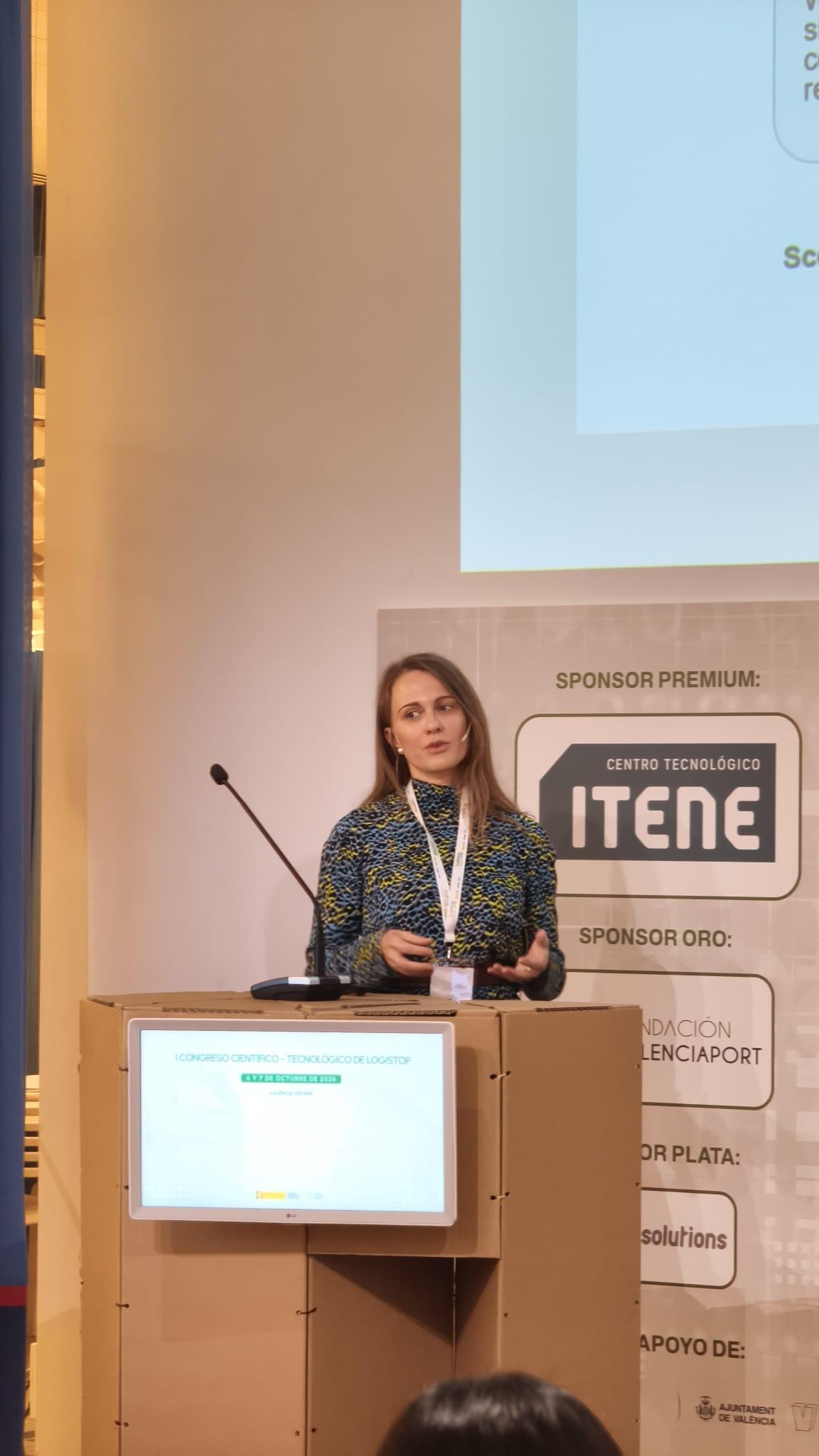
The IKIGAI project was presented at the 1st LOGISTOP Scientific and Technological Congress, held on 6-7 October 2026 in Valencia, Spain. Stefania Pesavento, Senior Innovation Consultant at Transport, Mobility & Logistics (TML), presented the project’s Paris use case, demonstrating how Physical Internet principles can be translated into practical urban logistics operations through synchromodal transport, data-driven coordination and shared infrastructure.
Organised by LOGISTOP, the Congress brought together businesses, researchers, technology providers and public institutions to explore the future of logistics under the theme “Logistics that connects, adapts and transforms”. Discussions covered sustainability, resilience, digitalisation, interoperability, intermodal transport and urban logistics, with an emphasis on translating innovation into practical applications.
From Physical Internet principles to urban logistics operations
Stefania’s presentation focused on the Paris demonstration within IKIGAI’s Smart and Synchromodal Urban Hubs pilot, which also includes a living lab in Esplugues, in the Barcelona metropolitan area. The initiative explores how shared infrastructure, sustainable transport modes and intelligent coordination can support more efficient, flexible and zero-emission last-mile logistics.
In Paris, the use case combines river transport with urban distribution, exploring how barges can function as mobile logistics hubs, with onboard sorting capabilities and cargo bikes supporting final delivery. The objective is not simply to replace road transport with inland waterways, but to coordinate different transport modes according to operational requirements.
As Stefania explained, synchromodality is about selecting and coordinating the right mode, at the right time, for the right flow. This requires looking beyond individual transport assets towards an integrated logistics system in which infrastructure, operators, data and transport services work together.
Building on real operations and measurable evidence
A central element of the Paris use case is its focus on existing ambient-temperature business-to-business (B2B) operations. Rather than developing a logistics model exclusively through theoretical assumptions, IKIGAI is starting from real operational flows to establish a baseline against which alternative configurations can be evaluated.
This approach makes it possible to assess how different transport arrangements perform in practice and identify opportunities for improvement. Operational data plays a critical role, providing the evidence needed to understand current performance, compare alternative scenarios and develop optimisation recommendations.
By connecting real-world operations with data-driven analysis, the use case aims to support informed decisions about how synchromodal urban logistics can be organised and improved. This includes understanding the conditions under which river transport, urban hubs and zero-emission last-mile vehicles can operate as parts of a coordinated system.
Scaling synchromodal logistics beyond a single demonstration
The longer-term ambition of the Paris use case is to determine whether the model can be expanded and replicated. Several questions will guide this next phase: can the approach be extended from ambient goods to temperature-controlled products? Can additional freight flows and logistics operators be integrated? And can operational processes be standardised sufficiently to support implementation in other cities?
These questions are particularly important from a Physical Internet perspective. The value of the demonstration lies not only in combining river transport with last-mile delivery, but in developing the interoperability, coordination mechanisms and standardised processes required for wider adoption.
The Paris and Esplugues living labs provide complementary environments for exploring these challenges. While Paris focuses on the potential of river-based mobile hubs, Esplugues examines fixed and mobile micro-logistics hubs and the coordination of zero-emission urban transport. Together, they contribute to IKIGAI’s broader objective of developing interconnected and collaborative logistics networks.
The presentation at LOGISTOP Congress reinforced an important distinction: a Physical Internet use case must demonstrate more than an innovative transport operation. It must explore how different actors, modes and resources can be coordinated, scaled and replicated through common processes and interoperable systems.
By grounding its approach in real operations and measurable performance, IKIGAI aims to generate practical evidence on how synchromodal logistics can contribute to more efficient, sustainable and collaborative urban freight networks.

IKIGAI and partners publish white paper on book and claim
IKIGAI contributed to a Smart Freight Centre-led white paper on implementing book and claim for low-emission road freight. With input from P&G, Normec Verifavia and GRUBER Logistics, it provides a verified, standardised framework enabling credible, scalable emissions reporting.
IKIGAI at the ALICE Brokerage Event 2026
IKIGAI participated in the ALICE Brokerage Event 2026 in Brussels, strengthening collaboration across Europe’s logistics ecosystem. Recognised during the General Assembly as a strategic milestone, IKIGAI advances Physical Internet governance and supports scalable, zero-emission freight innovation aligned with Horizon Europe 2026-2027 ambitions.
IKIGAI advances business adoption of reusable SmartBoxes with LI5 kick-off in Brussels
On 13 January 2026, the IKIGAI Project held the hybrid kick-off meeting of Logistics Innovation 5 (LI5) “GS1 SMART-Box pooling governance scaling up to Belgium and France” in Brussels and online. The event was hosted by GS1 Europe. LI5 addresses the specific business challenge of deploying reusable, standardised modular boxes on a large scale through open, economically viable pooling models.

Project coordinator
ikigai@fitconsulting.it

This project has received funding from the European Union’s Horizon Europe research and innovation programme under grant agreement No 101202912. Views and opinions expressed are however those of the author(s) and do not necessarily reflect those of the European Union or the granting authority. Neither the European Union nor the granting authority can be held responsible