
The IKIGAI project continues to advance its portfolio of logistics innovations, strengthening alignment with the Physical Internet (PI) through the development of collaborative, standardised and digitally enabled logistics systems. By bringing together industry stakeholders, governance frameworks and interoperable technologies, IKIGAI demonstrates how freight transport can evolve towards scalable, zero-emission and interconnected networks.
Across all Logistics Innovations (LI1-LI5), the focus lies on enabling structured collaboration, improving asset utilisation and establishing common operational processes that can be replicated across European logistics ecosystems.
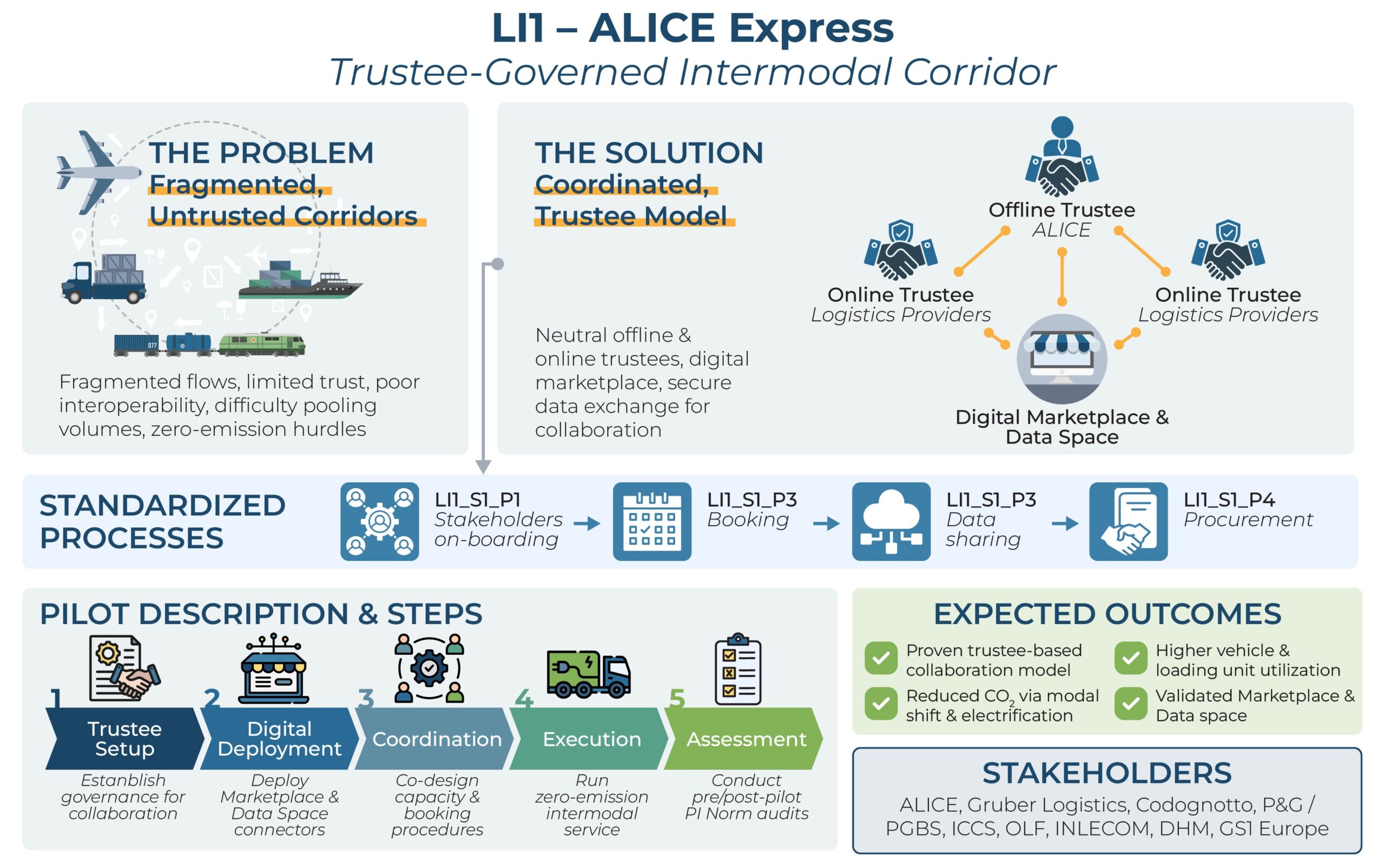
Trustee matchmaking and volume pooling: ALICE Express (LI1)
ALICE Express enables collaborative intermodal transport through a trustee-based model that connects shippers, logistics service providers and intermodal operators within a shared corridor ecosystem. By aggregating freight volumes and aligning service requirements, the pilot establishes the conditions needed to make intermodal transport more efficient, reliable and competitive.
A neutral trustee coordinates the onboarding of participants, structures data sharing and ensures that collaboration operates under transparent governance rules. This framework supports the harmonisation of freight flows, the identification of high-potential corridors and the alignment of capacity across stakeholders. Supported by digital tools for matchmaking and coordination, ALICE Express facilitates better use of existing infrastructure and contributes to the development of integrated, lower-emission transport solutions.
eFTI-compliant collaborative platform for SMEs: Piraeus (LI2)
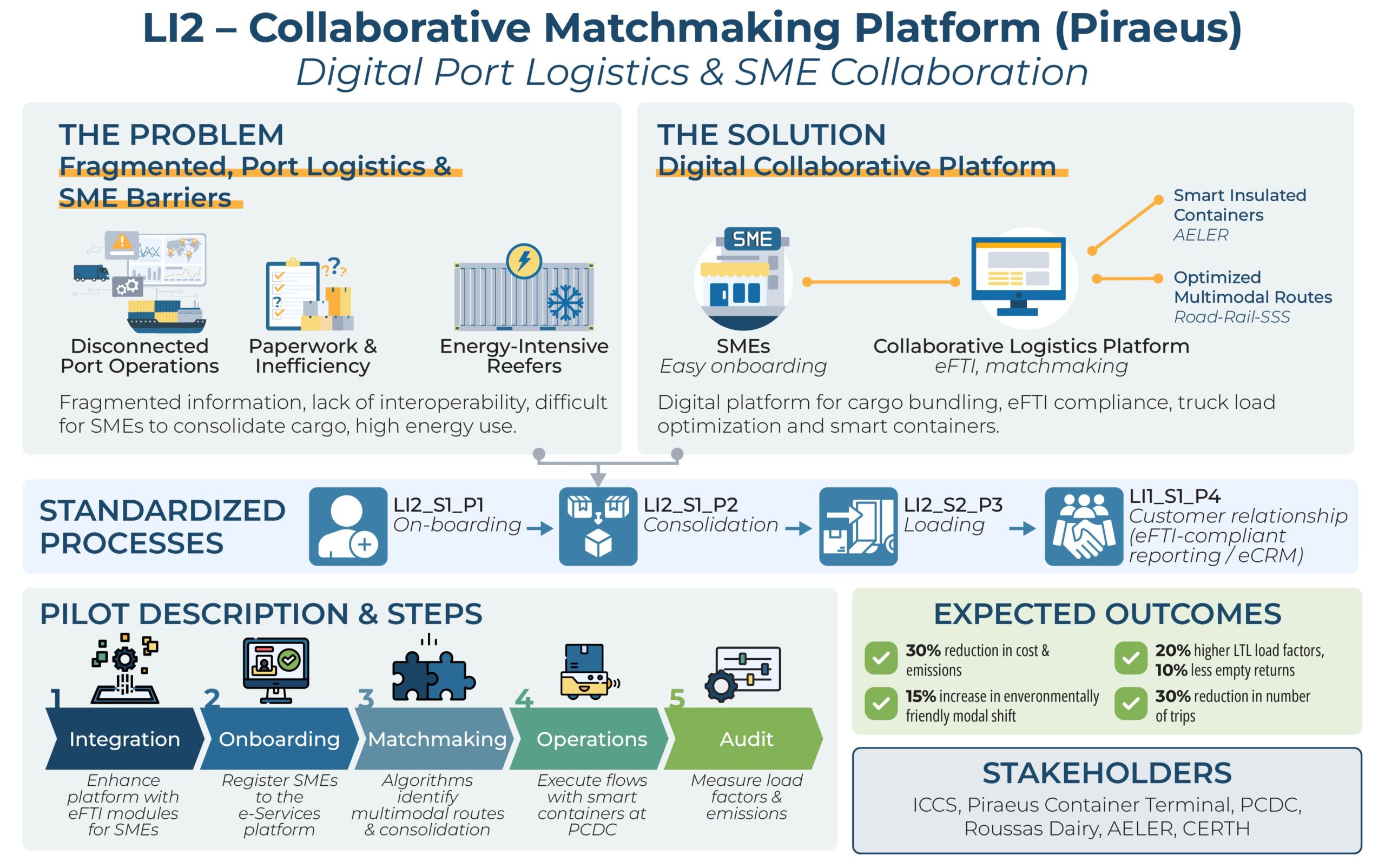
The Piraeus pilot develops a Collaborative Logistics Platform that enables small and medium-sized enterprises (SMEs) to participate in coordinated, multimodal freight transport. Through structured onboarding and digital integration, the platform connects shippers, logistics providers and terminal operations within a unified operational environment.
The platform supports cargo consolidation, load optimisation and synchromodal routing, allowing multiple shipments to be combined into standardised transport units and allocated efficiently across available capacity. At the same time, it ensures compliance with the electronic Freight Transport Information (eFTI) framework, enabling seamless data exchange and reducing administrative complexity.
By combining digital interoperability with operational coordination, the platform improves efficiency across the logistics chain while supporting more sustainable transport solutions, including the use of energy-efficient alternatives in temperature-controlled logistics.
Smart and synchromodal urban hubs: Paris and Esplugues (LI3)
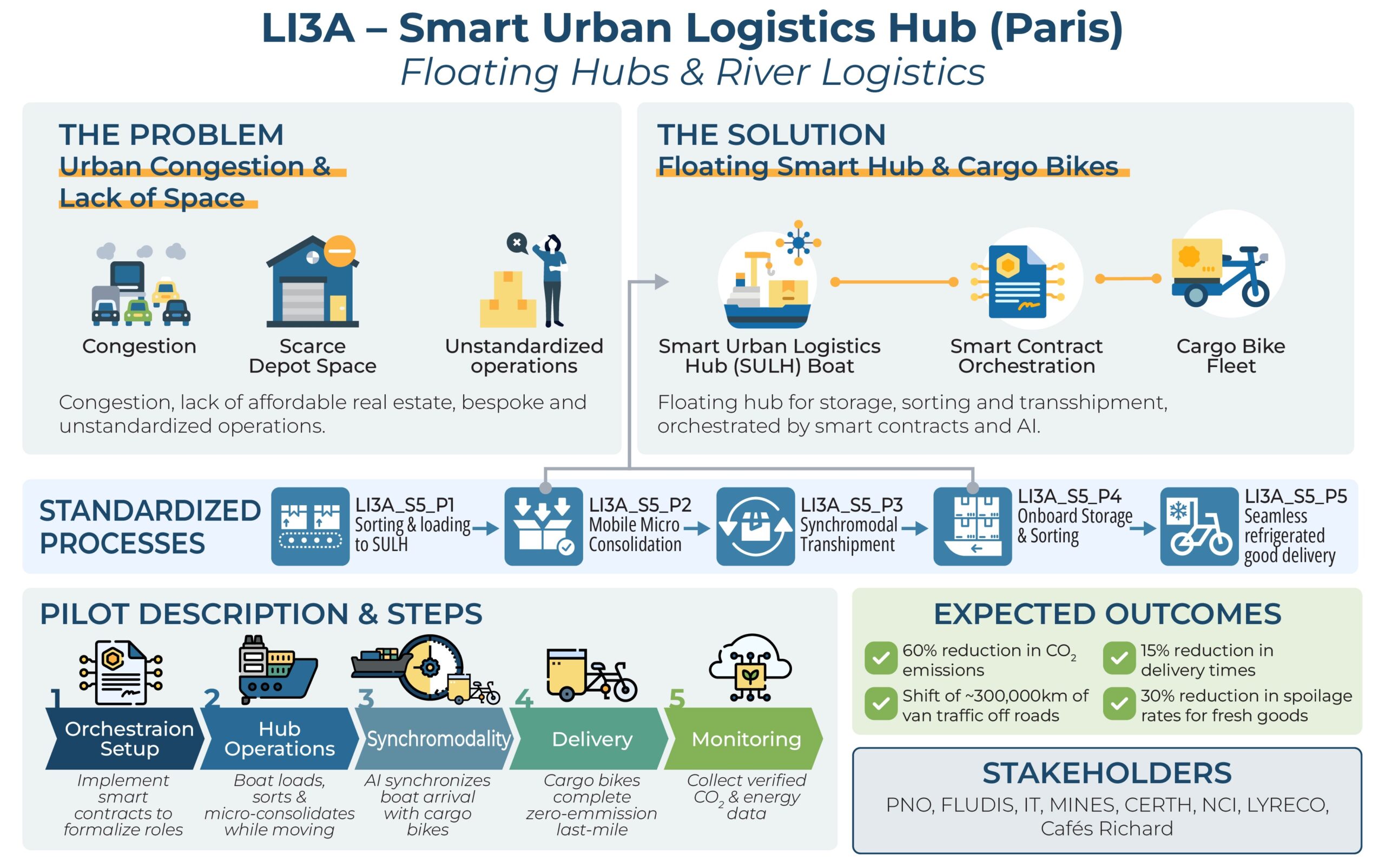
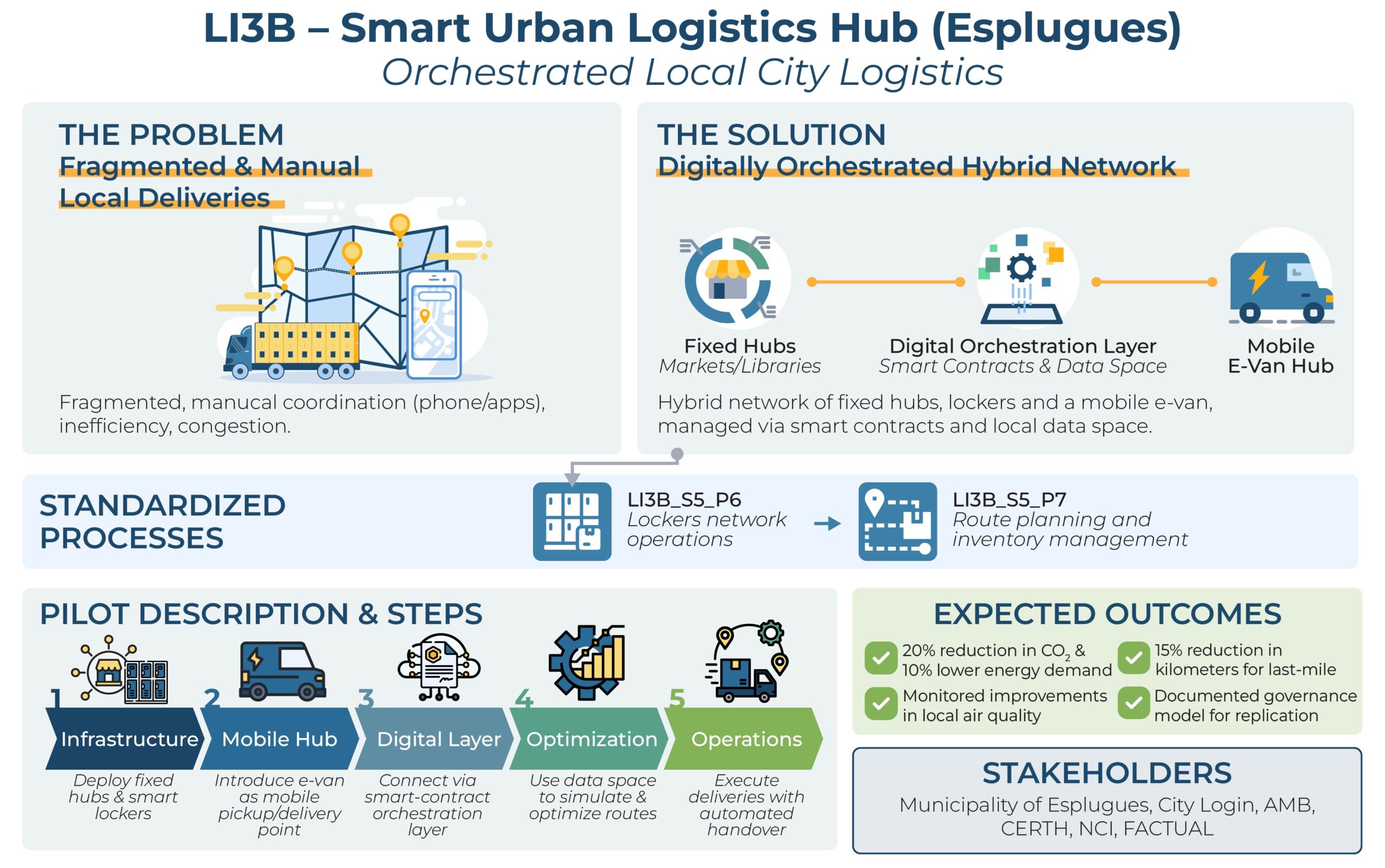
The IKIGAI urban logistics pilots demonstrate how last-mile delivery can be organised through synchromodal, zero-emission systems supported by shared infrastructure and digital orchestration.
In Paris, a floating logistics hub operating on inland waterways enables the consolidation, sorting and distribution of goods, which are then delivered through coordinated cargo-bike operations. The system integrates river and road-based modes into a unified workflow, supported by real-time coordination and standardised operational processes.
In Esplugues, a hybrid network of fixed and mobile hubs enables flexible and efficient urban distribution using electric vehicles. The integration of mobile hubs within the logistics system allows for dynamic routing and improved responsiveness to demand, while maintaining a fully zero-emission delivery model.
Across both pilots, the combination of standardised procedures, digital coordination and shared infrastructure demonstrates how urban logistics can be transformed into efficient, scalable and environmentally sustainable systems.
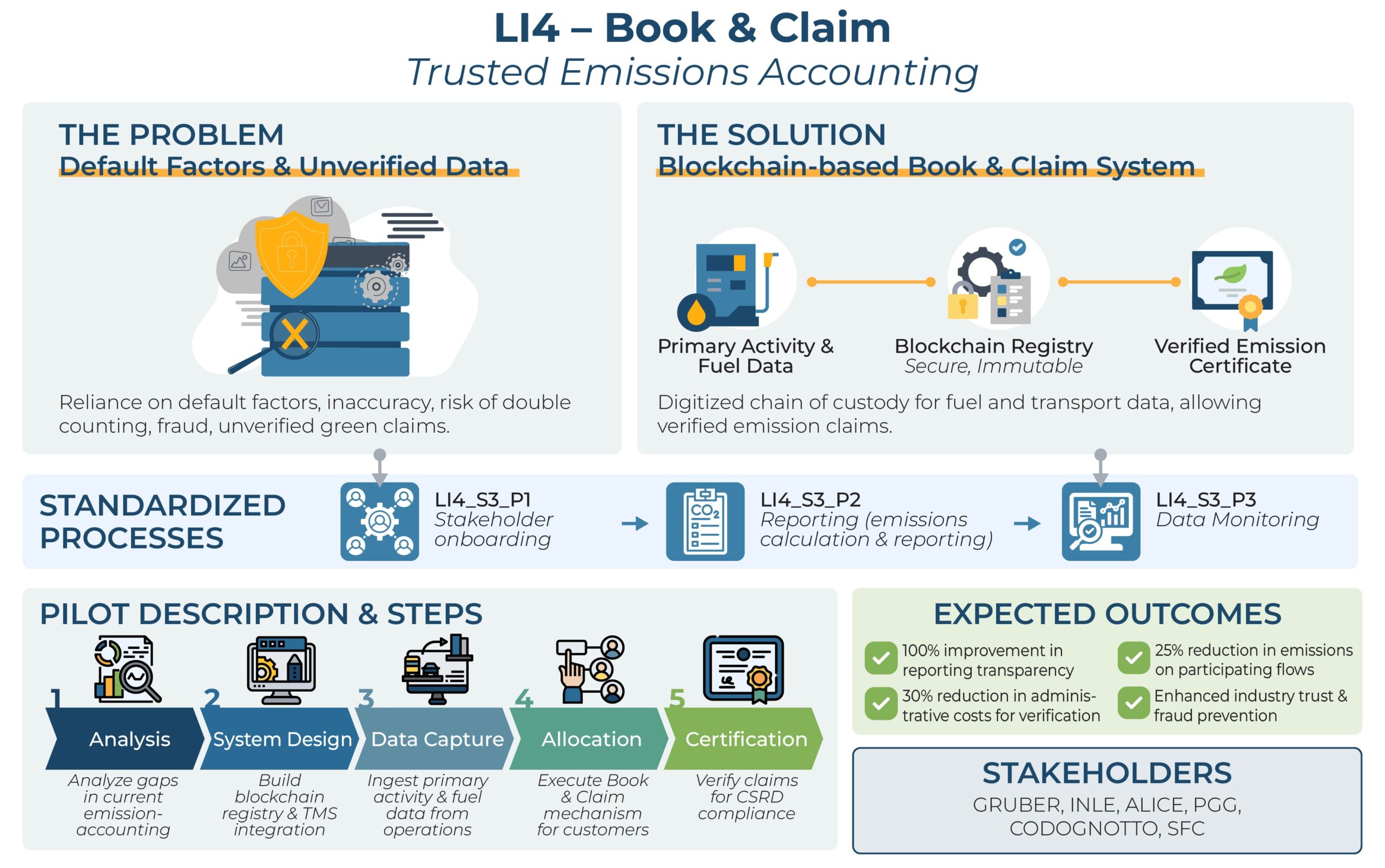
Trusted emissions accounting: Book & Claim (LI4)
The Book & Claim solution introduces a governance and accounting mechanism that enables collaborative efficiency improvements across freight transport systems. By separating transport execution from sustainability claims, it allows stakeholders to benefit from verified performance improvements without requiring direct asset sharing.
Operational data is collected and analysed within a neutral platform to identify efficiency gains such as improved load factors and reduced empty mileage. These improvements are converted into verified units, which are allocated to stakeholders through a transparent and auditable process supported by predefined rules and digital governance mechanisms.
This approach enables credible emissions accounting and supports compliance with sustainability reporting requirements, while fostering collaboration across actors that operate independently within the logistics ecosystem.
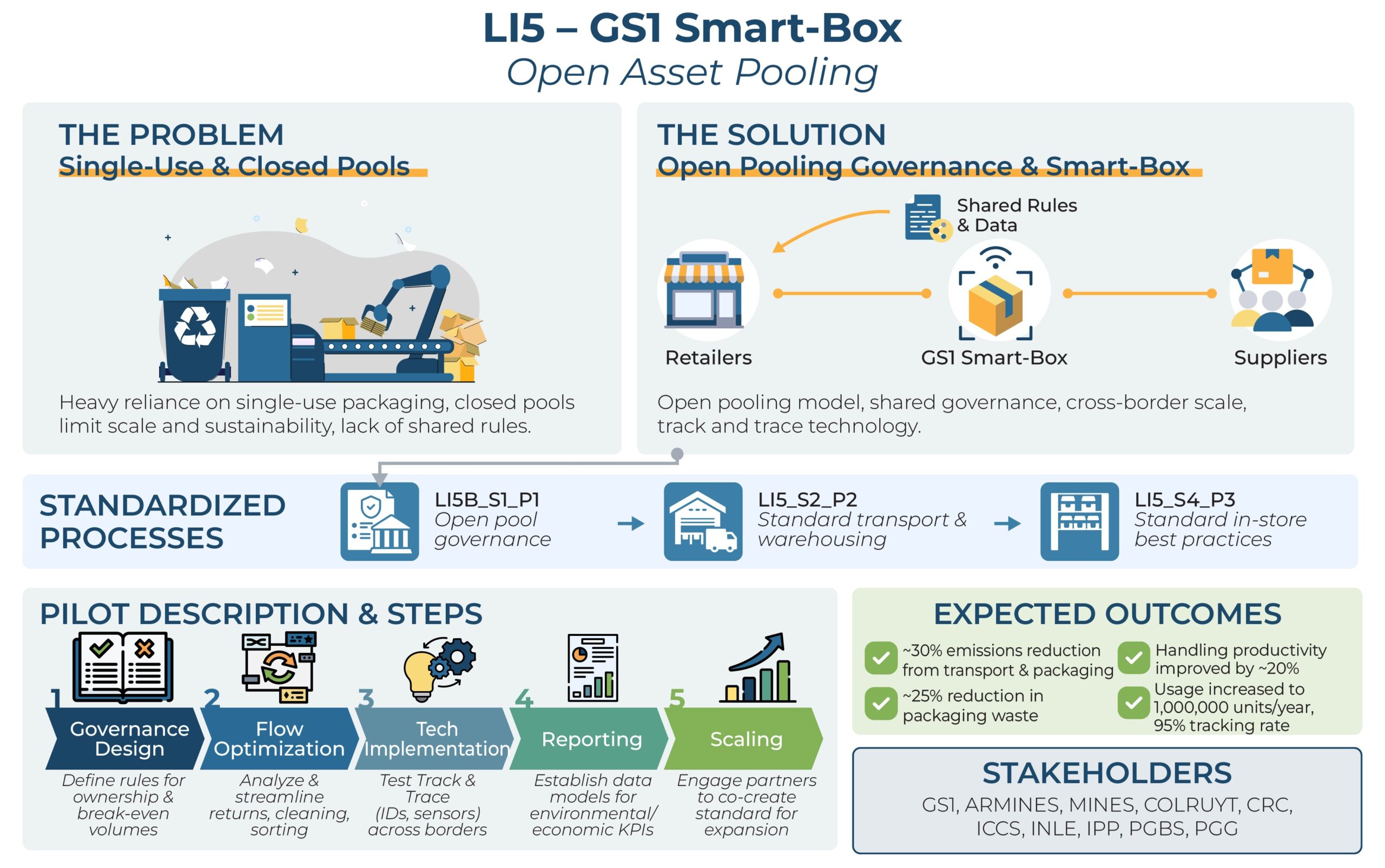
Open pooling and reusable logistics assets: GS1 Smart-Box (LI5)
The GS1 Smart-Box pilot introduces a standardised, reusable modular box supported by an open pooling and governance model. The initiative enables multiple stakeholders to share logistics assets within a common framework, improving interoperability and efficiency across supply chains.
The system combines harmonised physical specifications with structured operational processes for transport, warehousing and reverse logistics. Digital tools support track-and-trace, flow optimisation and performance monitoring, ensuring visibility and control across the lifecycle of the assets.
By aligning governance, operations and digital capabilities, the Smart-Box solution enables more efficient use of space, reduces packaging waste and supports the transition towards circular and collaborative logistics systems.
Towards a connected logistics system
Through these innovations, IKIGAI demonstrates how logistics can evolve from fragmented operations to interconnected, collaborative systems. By combining governance models, digital platforms and standardised processes, the project lays the foundations for scalable and zero-emission freight transport aligned with the Physical Internet vision.
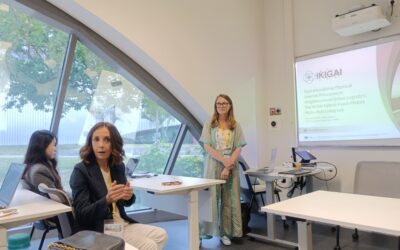
Urban Living Labs and sustainable implementation at IPIC 2026
At IPIC 2026, the session “Urban Living Labs and Sustainable Implementation” showcased how projects including IKIGAI are translating Physical Internet concepts into practical urban logistics solutions through living labs, stakeholder collaboration and scalable approaches for sustainable last-mile delivery.
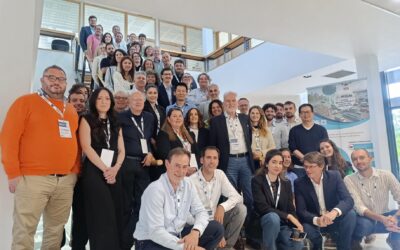
IKIGAI General Assembly
The IKIGAI General Assembly, held alongside IPIC 2026 in Bordeaux, brought project partners together to review progress, align upcoming activities and prepare for pilot deployment. Discussions focused on scaling logistics innovations beyond demonstrations, strengthening stakeholder engagement through the Physical Internet Ambassadors community, and supporting the transition towards more collaborative, interoperable and sustainable Physical Internet-enabled logistics networks.
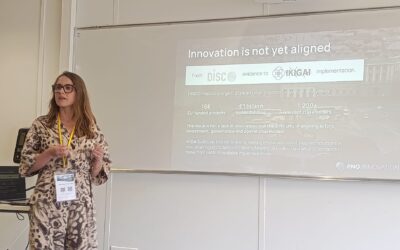
IKIGAI at IPIC 2026: Multimodal hubs, ports and deployable nodes
At IPIC 2026 in Bordeaux, the IKIGAI project showcased methodologies and tools to help scale Physical Internet innovations beyond pilot projects. Discussions highlighted the importance of interoperability, governance, stakeholder collaboration and readiness assessment to accelerate the deployment of scalable, zero-emission logistics solutions.

Project coordinator
ikigai@fitconsulting.it

This project has received funding from the European Union’s Horizon Europe research and innovation programme under grant agreement No 101202912. Views and opinions expressed are however those of the author(s) and do not necessarily reflect those of the European Union or the granting authority. Neither the European Union nor the granting authority can be held responsible