
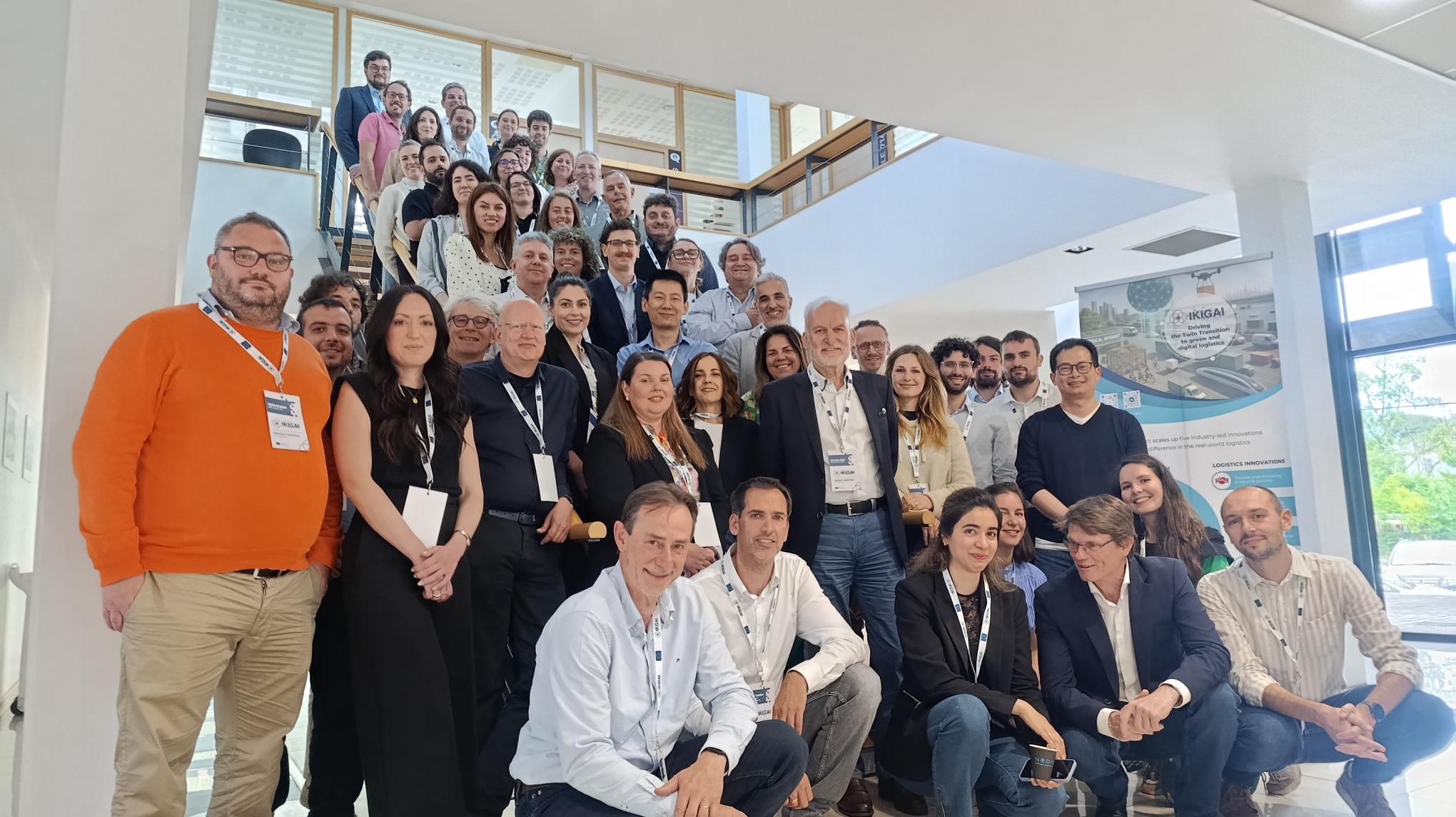
The IKIGAI General Assembly, held alongside IPIC 2026 in Bordeaux, brought together project partners to review progress, align upcoming activities and discuss how logistics innovations developed within the project can contribute to the broader transition towards Physical Internet-enabled logistics networks.
A key message throughout the meeting was that IKIGAI goes beyond the development of individual logistics innovations and pilot demonstrations. The project’s ambition is to transform practical experiences into scalable and replicable approaches that support more collaborative, interoperable and sustainable logistics systems. Partners discussed how project activities can contribute to long-term roadmaps and frameworks that help organisations move from siloed operations towards network-based collaboration, shared assets and distributed trust models.
Moving from innovation pilots to scalable solutions
During the General Assembly, partners reviewed progress across the project’s technical work, including the development of the Physical Internet framework, readiness assessment methodologies, deployment plans and implementation guidelines that will support the next phase of pilot activities.
Discussions highlighted the importance of generating evidence through real-life demonstrations. Pilot implementation will play a central role in validating solutions, measuring environmental and operational impacts, identifying barriers and providing practical insights that can support future replication and scale-up.
The project is now entering a critical phase in which logistics innovations move from design and preparation into operational deployment. Partners discussed the need to capture not only performance improvements but also lessons learned regarding collaboration models, interoperability, governance approaches and stakeholder engagement.
Physical Internet Ambassadors challenge conventional thinking
One of the most engaging sessions of the General Assembly involved the Physical Internet Ambassadors community, which brings together experts from industry, research and innovation ecosystems to support the project with external perspectives and practical insights.
A particularly thought-provoking discussion focused on packaging and supply chain efficiency. Ambassadors explored whether overpackaging should be viewed purely as a packaging issue or rather as a symptom of broader inefficiencies across supply chains.
Participants noted that packaging decisions are often used to compensate for challenges elsewhere in logistics systems, including fragmented operations, inefficient transport processes, limited visibility, insufficient standardisation and disconnected decision-making structures. The discussion highlighted how packaging, transport, warehousing and logistics operations are deeply interconnected and should be addressed through systemic approaches rather than isolated interventions.
The exchange also explored how new technologies, collaborative models and common standards could help improve asset utilisation, increase visibility across supply chains and support circular approaches for logistics assets and packaging solutions.
Strengthening stakeholder engagement and future impact
The General Assembly also explored how the Physical Internet Ambassadors can support project activities beyond advisory discussions. Partners discussed opportunities for ambassadors to contribute directly to logistics innovations, provide feedback on pilot developments, connect project activities with wider industry networks and help accelerate future adoption.
These discussions reinforced the importance of involving stakeholders beyond the project consortium. By combining pilot evidence, industry expertise and external perspectives, IKIGAI aims to maximise the impact of its results and support broader deployment of Physical Internet principles across European logistics networks.
As implementation activities accelerate, IKIGAI continues to demonstrate how collaboration, innovation and stakeholder engagement can help shape the future of more connected, efficient and sustainable supply chains.
IKIGAI at Gruber Logistics Innovation Summit
At the Gruber Logistics Innovation Summit, Fernando Liesa and Sergio Barbarino highlighted the importance of collaboration in addressing the challenges facing logistics. Discussions focused on the Physical Internet, innovation deployment, automation and AI, emphasising that resilient and sustainable supply chains require not only technological advances but also stronger collaboration across organisations and stakeholders. Their contributions closely reflected the ambitions of the IKIGAI Project, which is accelerating the transition towards collaborative, interconnected and zero-emission freight transport systems.

Physical Internet maturity model for corporations
The ALICE–JPIC webinar explored Japan’s Physical Internet Maturity Model (PIMM), highlighting how structured maturity frameworks, collaboration and international exchange can support scalable, interoperable and zero-emission logistics transformation.
Physical Internet neighbourhood cross-fertilisation workshop for TRA 2026
ALICE brought together IKIGAI, HOLOGISTICS, PILOTS, BRIDGE and SARIL to strengthen collaboration ahead of TRA 2026. The workshop explored synergies across complementary projects advancing the Physical Internet through interoperability, digitalisation, resilience and collaborative logistics solutions.

Project coordinator
ikigai@fitconsulting.it

This project has received funding from the European Union’s Horizon Europe research and innovation programme under grant agreement No 101202912. Views and opinions expressed are however those of the author(s) and do not necessarily reflect those of the European Union or the granting authority. Neither the European Union nor the granting authority can be held responsible