
At the Gruber Logistics Innovation Summit, two contributions resonated strongly with the ambitions of the IKIGAI Project. Fernando Liesa, Secretary General of the Alliance for Logistics Innovation through Collaboration in Europe (ALICE), presented a strategic vision for the future of freight transport based on collaboration, interoperability and the Physical Internet. Later in the programme, Sergio Barbarino led discussions on the opportunities and challenges that automation and artificial intelligence (AI) are creating for logistics organisations and their workforce.
Together, their contributions highlighted a common message: achieving a sustainable, resilient and competitive logistics system will require not only technological innovation, but also new forms of collaboration across the entire supply chain.
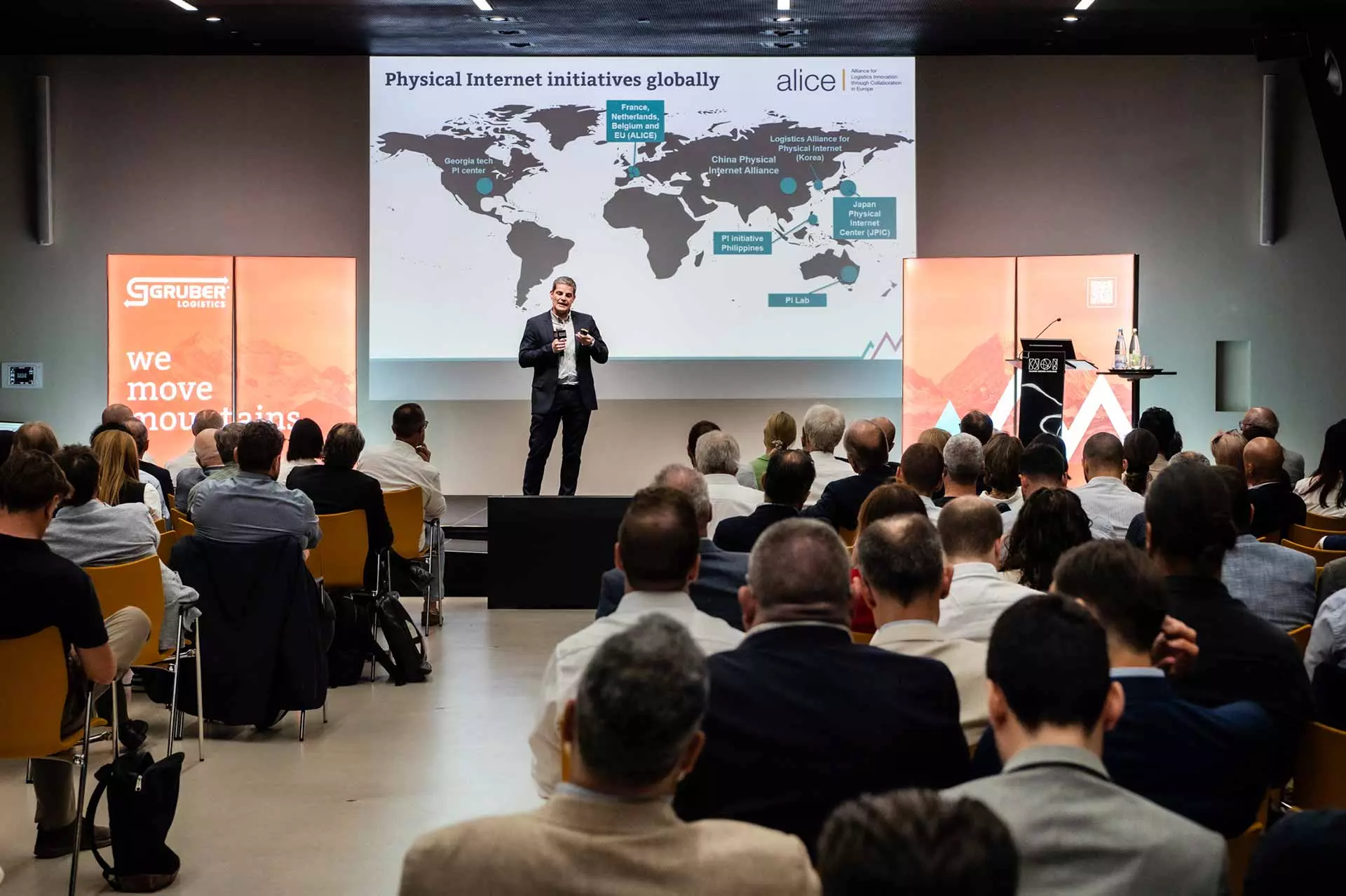
Fernando Liesa on driving innovation through collaboration: emerging trends
In his presentation, Fernando Liesa explored the major transformations currently reshaping supply chains. Decarbonisation and the energy transition, digitalisation and automation, resource scarcity, and growing geopolitical uncertainty are placing increasing pressure on logistics systems and business models.
Against this backdrop, Fernando argued that fragmented supply chains can no longer deliver the efficiency, resilience and sustainability required for the future. Instead, he highlighted the Physical Internet as a framework for creating interconnected logistics networks based on shared resources, standardised processes and real-time data exchange.
The Physical Internet enables organisations to collaborate at scale while maintaining competitiveness. Through greater interoperability and network integration, companies can improve asset utilisation, reduce emissions and strengthen supply chain resilience. These principles are central to the IKIGAI Project, which seeks to accelerate the transition towards collaborative and zero-emission freight transport solutions.
Fernando also emphasised that the Physical Internet is gaining momentum well beyond Europe. Initiatives across Asia, North America and other regions demonstrate growing international commitment to transforming logistics through collaboration and innovation.
Another key element of his presentation was the need to bridge the gap between research and market deployment. Through ALICE’s innovation framework, Fernando illustrated how technological development, policy support, standardisation and real-world applications must work together to scale innovation and maximise impact.
This approach is reflected in IKIGAI’s own activities. Through demonstrators such as the ALICE Express collaborative intermodal service, the reusable GS1 Smart Box, the eFTI-enabled collaboration platform for SMEs, and the digital chain of custody solution for emissions visibility, the project is testing practical pathways towards the large-scale adoption of Physical Internet concepts.
Sergio Barbarino on automation, AI and the future logistics workforce
The human dimension of innovation took centre stage during the thematic session on Automation and Artificial Intelligence, moderated by Sergio Barbarino.
Drawing on his extensive experience in collaborative innovation and supply chain transformation, Sergio guided discussions on how automation and AI are reshaping logistics operations, decision-making processes and workforce requirements. Participants explored the opportunities offered by emerging technologies, while also reflecting on the organisational changes needed to unlock their full potential.
The discussion highlighted that relying on AI alone will be a very inefficient way to drive transformation. The successful adoption of automation and AI depends on people, skills and collaborative standardisation (eFTI). It will consume much less energy while paving the way to the objective of increasingly connected and data-driven supply chains.
The session reinforced an important lesson for the logistics sector: innovation delivers the greatest value when technological progress is combined with collaboration across organisations and supply chain partners. This perspective aligns closely with the Physical Internet vision, where digital technologies act as enablers of more integrated, efficient and sustainable logistics networks.
A shared vision for the future of logistics
Although their presentations addressed different aspects of logistics transformation, Fernando Liesa and Sergio Barbarino pointed towards the same destination.
The challenges facing the sector, from decarbonisation and resource constraints to digital transformation and increasing uncertainty – cannot be solved through isolated actions. They require collaborative approaches that connect organisations, technologies and stakeholders across the logistics ecosystem.
This vision lies at the heart of the IKIGAI Project. By bringing together industry leaders, technology providers, researchers and policymakers, IKIGAI is helping to accelerate the transition towards a Physical Internet that is more sustainable, resilient, affordable and scalable.
As Fernando Liesa reminded participants, the best way to predict the future is to co-create it. Through collaboration-driven innovation, the logistics community has an opportunity to build a freight transport system capable of delivering both economic competitiveness and zero-emission mobility for future generations.
IKIGAI at IPIC 2026: Multimodal hubs, ports and deployable nodes
At IPIC 2026 in Bordeaux, the IKIGAI project showcased methodologies and tools to help scale Physical Internet innovations beyond pilot projects. Discussions highlighted the importance of interoperability, governance, stakeholder collaboration and readiness assessment to accelerate the deployment of scalable, zero-emission logistics solutions.

Physical Internet maturity model for corporations
The ALICE–JPIC webinar explored Japan’s Physical Internet Maturity Model (PIMM), highlighting how structured maturity frameworks, collaboration and international exchange can support scalable, interoperable and zero-emission logistics transformation.
Physical Internet neighbourhood cross-fertilisation workshop for TRA 2026
ALICE brought together IKIGAI, HOLOGISTICS, PILOTS, BRIDGE and SARIL to strengthen collaboration ahead of TRA 2026. The workshop explored synergies across complementary projects advancing the Physical Internet through interoperability, digitalisation, resilience and collaborative logistics solutions.

Project coordinator
ikigai@fitconsulting.it

This project has received funding from the European Union’s Horizon Europe research and innovation programme under grant agreement No 101202912. Views and opinions expressed are however those of the author(s) and do not necessarily reflect those of the European Union or the granting authority. Neither the European Union nor the granting authority can be held responsible