
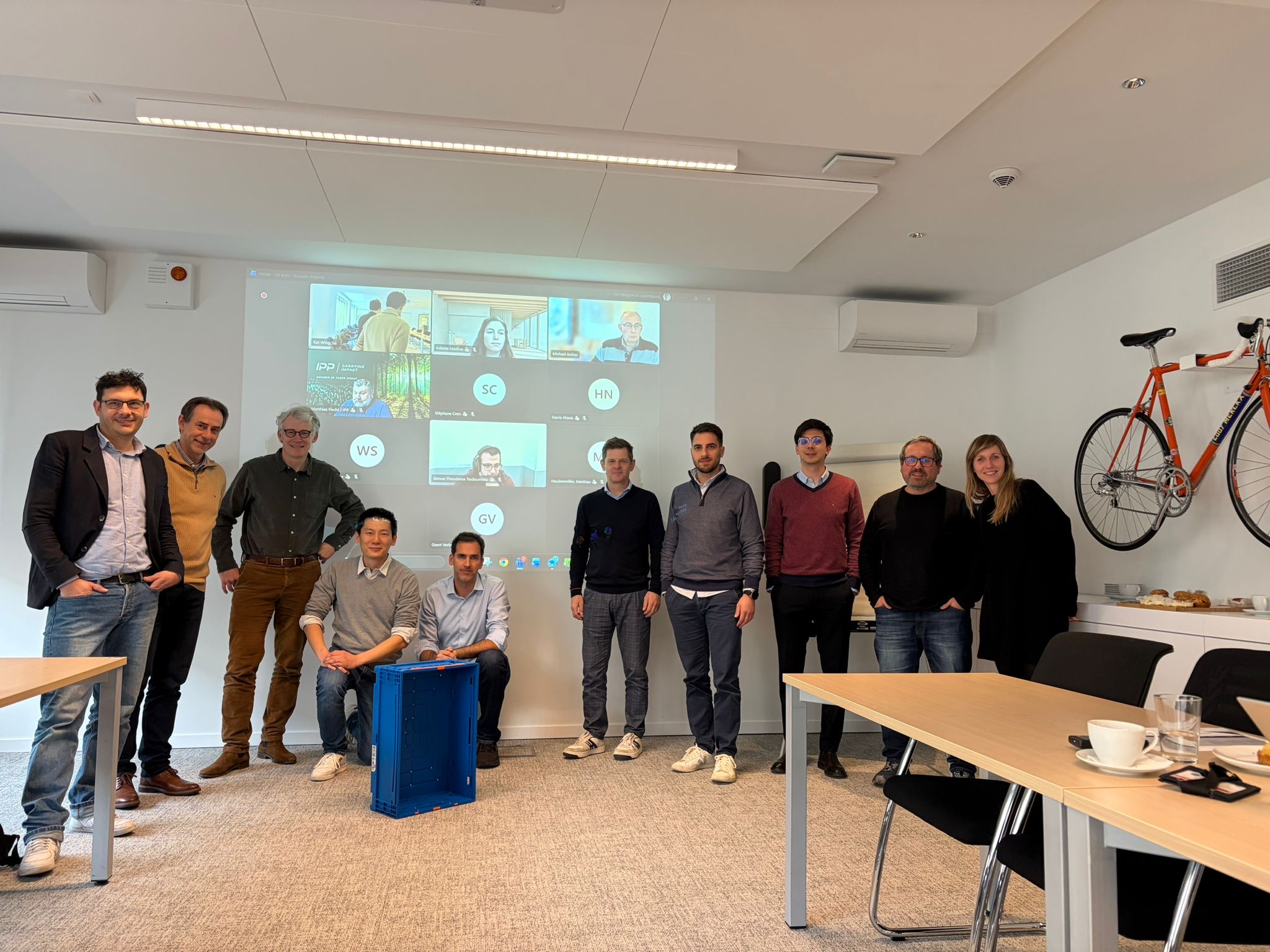
On 13 January 2026, the IKIGAI Project held the hybrid kick-off meeting of Logistics Innovation 5 (LI5) “GS1 SMART-Box pooling governance scaling up to Belgium and France” in Brussels and online. The event was hosted by GS1 Europe. LI5 addresses the specific business challenge of deploying reusable, standardised modular boxes on a large scale through open, economically viable pooling models.
Advancing reusable and standardised logistics assets
Key topics discussed
-
Real-world use cases, covering automated distribution centres, shelf-ready packaging, display logistics and home delivery
-
Pooling and governance models, addressing ownership, cost allocation, clearing mechanisms and scalability
-
Digital enablers, such as event tracking, smart contracts and digital twins, to support traceability, transparency and operational efficiency
Building the foundation for pilot execution
IKIGAI Task 3.5 Kick-off Meeting (KoM) workshop
Book & Claim is emerging as a key near-term solution for road freight decarbonisation, enabling credible biofuel claims across complex supply chains where electrification is not yet scalable, provided robust governance, verification and interoperability are ensured.

IKIGAI consortium meets online
The IKIGAI consortium held its second project-wide meeting, reviewing early progress, aligning work packages, and advancing pilot planning. Discussions were focused and constructive, reinforcing coordination and setting a clear roadmap for the next phase.
Save the date: IPIC 2026 – a milestone for the future of the Physical Internet
IPIC 2026 will bring the global Physical Internet community to Bordeaux and Albi to explore how high-tech and low-tech solutions can jointly accelerate intelligent, collaborative and zero-emission logistics.