The transition towards a Physical Internet requires more than individual innovations. It requires projects, organisations and stakeholders to work together, exchange knowledge and build a shared understanding of how collaborative, interoperable and sustainable logistics systems can be deployed at scale.
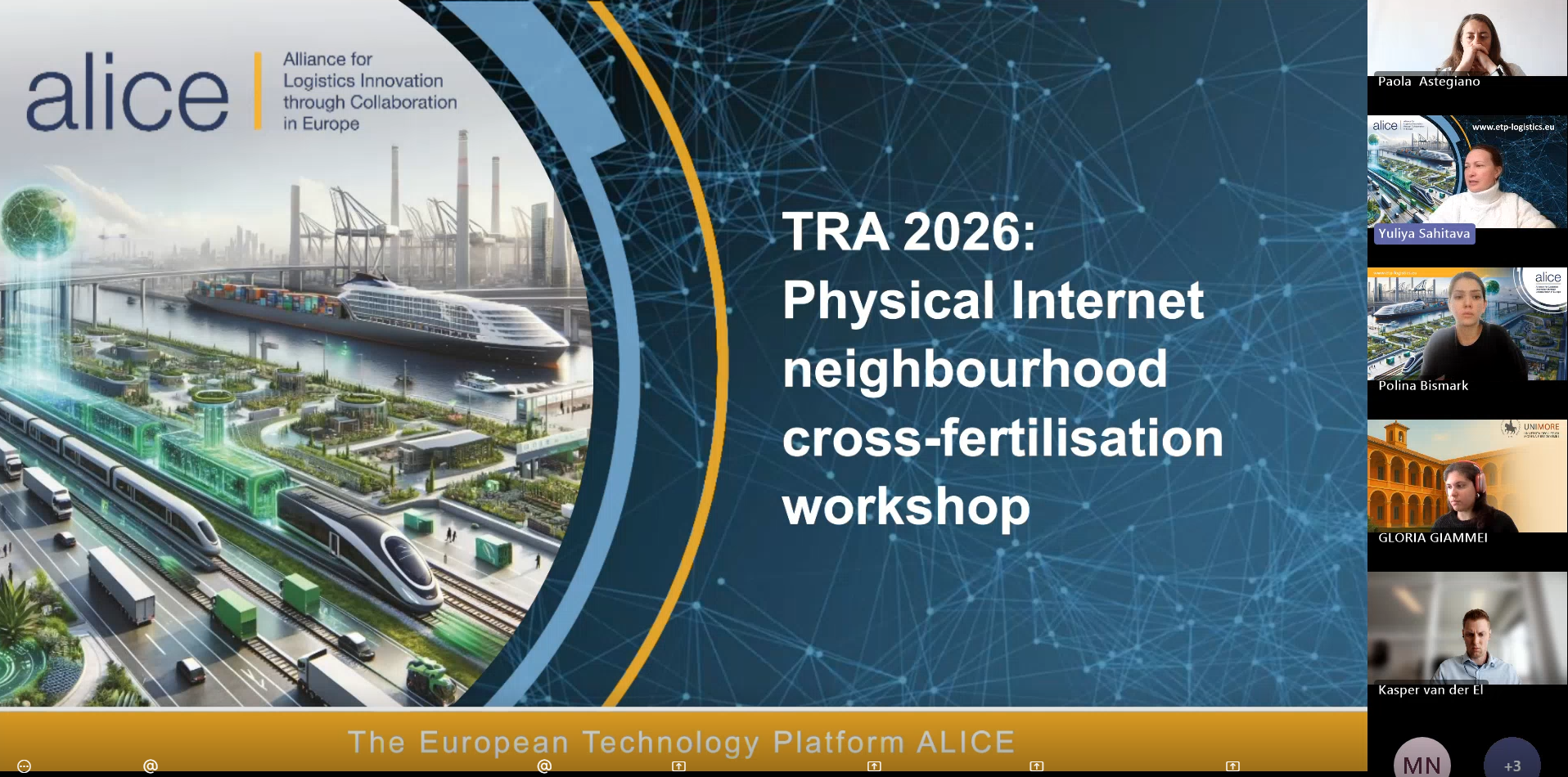
This was the objective of the Physical Internet Neighbourhood Cross-Fertilisation Workshop organised by ALICE in preparation for TRA 2026. Bringing together representatives from IKIGAI, HOLOGISTICS, PILOTS, BRIDGE and SARIL, the workshop provided an opportunity to explore complementarities between projects, strengthen collaboration and prepare a coordinated presence at one of Europe’s leading transport research and innovation events.
Advancing the Physical Internet through complementary innovations
Although each project addresses different challenges, all contribute to the broader Physical Internet vision: transforming fragmented logistics operations into interconnected, resilient, efficient and zero-emission logistics ecosystems.
The workshop highlighted how participating projects approach this ambition from different but complementary perspectives.
IKIGAI focuses on accelerating the implementation of the Physical Internet through collaborative logistics ecosystems, interoperable digital systems, shared transport capacity, reusable assets and innovative governance models. HOLOGISTICS develops interoperable innovations combining physical, digital and governance solutions to improve efficiency and reduce emissions. PILOTS addresses process-aware interoperability and automated data exchange between logistics actors. BRIDGE works on seamless data sharing across intermodal freight transport, while SARIL strengthens resilience and disruption management across logistics networks.
Together, these initiatives demonstrate that the Physical Internet is not a single technology or solution. It is a systemic approach that combines collaboration, interoperability, digitalisation, resilience and sustainability to transform freight transport.
Creating synergies across European logistics initiatives
A central objective of the workshop was to encourage knowledge exchange across projects and identify areas of mutual interest.
Rather than presenting projects in isolation, participants were invited to explain their initiatives in a way that would allow representatives from other projects to confidently present them to visitors during TRA 2026. This approach encouraged participants to look beyond their own project boundaries and develop a broader understanding of the innovation landscape supporting the Physical Internet.
The discussions highlighted multiple connections between projects. Digital interoperability emerged as a common theme linking PILOTS, BRIDGE and IKIGAI. Collaborative logistics and shared resources created strong links between IKIGAI and HOLOGISTICS. Synchromodal transport and multimodal coordination connected IKIGAI, HOLOGISTICS, BRIDGE and SARIL, while resilience, sustainability and decarbonisation remained shared priorities across the entire neighbourhood.
These exchanges not only strengthened mutual understanding but also highlighted opportunities for future collaboration and knowledge transfer between projects.
Preparing a coordinated Physical Internet presence at TRA 2026
The workshop also served as an important step in preparing the Physical Internet Neighbourhood at TRA 2026.
Visitors to the neighbourhood will be introduced to a portfolio of complementary European initiatives addressing different dimensions of logistics transformation, from interoperability and digitalisation to collaborative transport, resilience and zero-emission operations.
To support this collective approach, project representatives will actively promote neighbouring initiatives and help visitors navigate the wider Physical Internet ecosystem. This collaborative model reflects the principles underpinning the Physical Internet itself: openness, interoperability, resource sharing and value creation through collaboration.
By presenting projects as part of a broader ecosystem rather than as isolated initiatives, the neighbourhood aims to provide stakeholders with a clearer understanding of how different innovations contribute to a common vision for the future of freight transport.
Strengthening collaboration beyond project boundaries
For IKIGAI, the workshop reinforced the importance of collaboration across the European research and innovation landscape.
Accelerating the implementation of the Physical Internet requires continuous dialogue between projects developing complementary solutions and addressing related challenges. Exchanges with initiatives such as HOLOGISTICS, PILOTS, BRIDGE and SARIL help strengthen connections across the ecosystem and create opportunities to build on shared knowledge and experience.
The Physical Internet will not be realised through a single project. Its implementation depends on collaboration across initiatives, sectors and stakeholders. Workshops such as this demonstrate how cross-project cooperation can help accelerate the transition towards a more connected, resilient, efficient and sustainable freight transport system.
IKIGAI at IPIC 2026: Multimodal hubs, ports and deployable nodes
At IPIC 2026 in Bordeaux, the IKIGAI project showcased methodologies and tools to help scale Physical Internet innovations beyond pilot projects. Discussions highlighted the importance of interoperability, governance, stakeholder collaboration and readiness assessment to accelerate the deployment of scalable, zero-emission logistics solutions.
IKIGAI at Gruber Logistics Innovation Summit
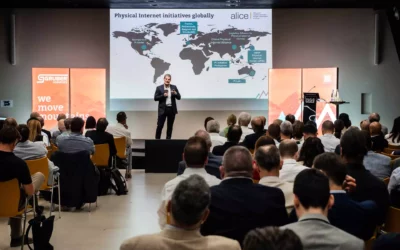
At the Gruber Logistics Innovation Summit, Fernando Liesa and Sergio Barbarino highlighted the importance of collaboration in addressing the challenges facing logistics. Discussions focused on the Physical Internet, innovation deployment, automation and AI, emphasising that resilient and sustainable supply chains require not only technological advances but also stronger collaboration across organisations and stakeholders. Their contributions closely reflected the ambitions of the IKIGAI Project, which is accelerating the transition towards collaborative, interconnected and zero-emission freight transport systems.
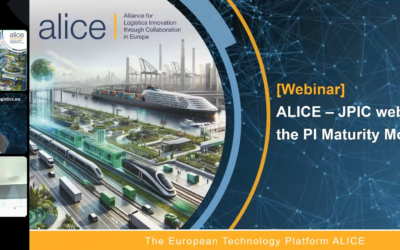
Physical Internet maturity model for corporations
The ALICE–JPIC webinar explored Japan’s Physical Internet Maturity Model (PIMM), highlighting how structured maturity frameworks, collaboration and international exchange can support scalable, interoperable and zero-emission logistics transformation.

Project coordinator
ikigai@fitconsulting.it

This project has received funding from the European Union’s Horizon Europe research and innovation programme under grant agreement No 101202912. Views and opinions expressed are however those of the author(s) and do not necessarily reflect those of the European Union or the granting authority. Neither the European Union nor the granting authority can be held responsible