
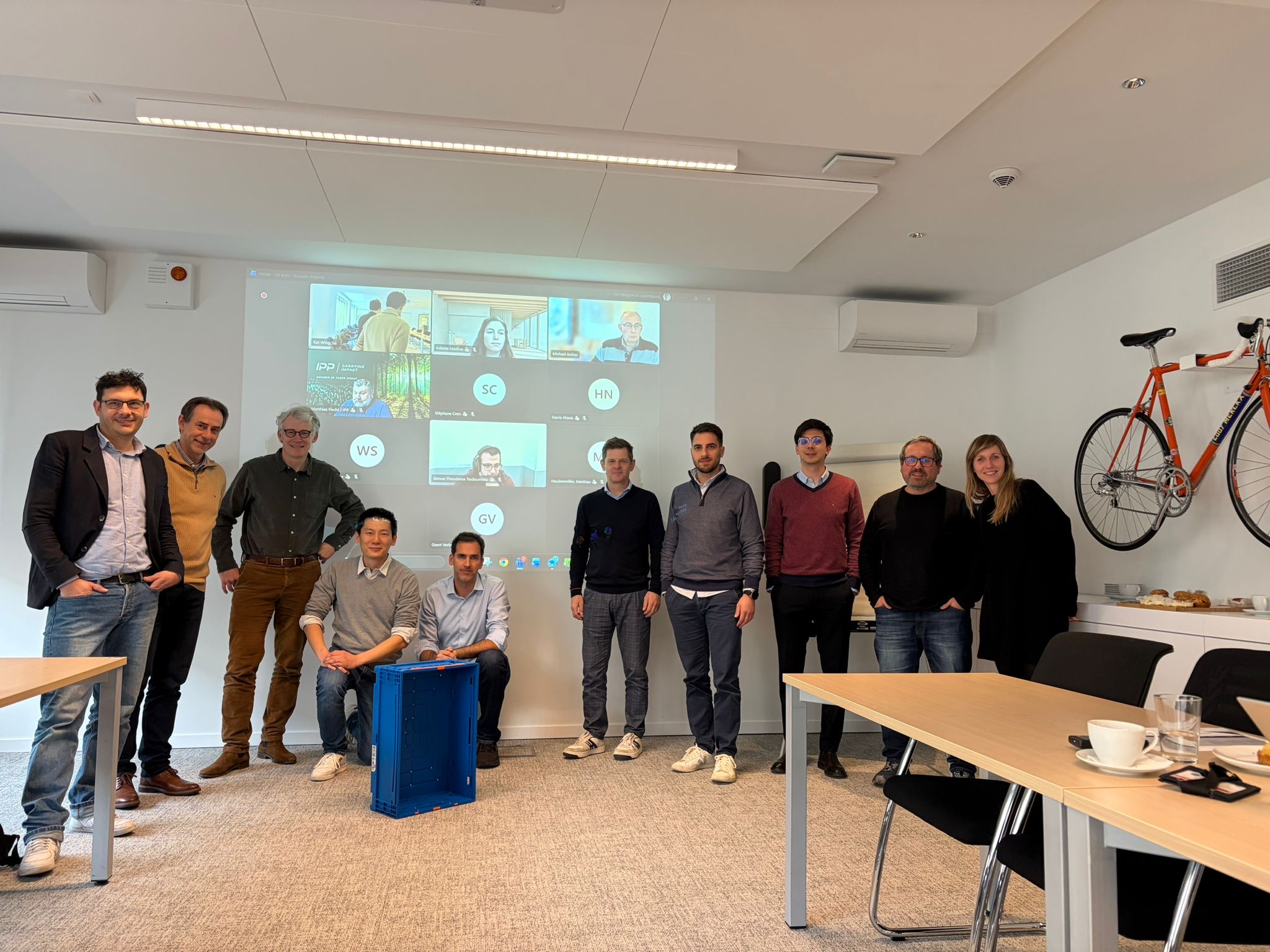
On 13 January 2026, the IKIGAI Project held the hybrid kick-off meeting of Logistics Innovation 5 (LI5) “GS1 SMART-Box pooling governance scaling up to Belgium and France” in Brussels and online. The event was hosted by GS1 Europe. LI5 addresses the specific business challenge of deploying reusable, standardised modular boxes on a large scale through open, economically viable pooling models.
Advancing reusable and standardised logistics assets
Key topics discussed
-
Real-world use cases, covering automated distribution centres, shelf-ready packaging, display logistics and home delivery
-
Pooling and governance models, addressing ownership, cost allocation, clearing mechanisms and scalability
-
Digital enablers, such as event tracking, smart contracts and digital twins, to support traceability, transparency and operational efficiency
Building the foundation for pilot execution
Webinar Physical Internet applications for containerised consolidation on public transport
Webinar explored Physical Internet applications for integrating freight into public transport, co-organised by IKIGAI, ALICE, DISCO, Shift2Zero and URBANE, highlighting urban and rural logistics improvements and emission reduction potential.
Strengthening global collaboration to advance the Physical Internet
The transition toward Physical Internet–enabled logistics is accelerating globally. The EU-funded IKIGAI project contributes by translating strategic vision into practical implementation through innovation, piloting and international cooperation supporting collaborative, interoperable and sustainable logistics networks.
Key takeaways from the International Expert workshop
An international expert workshop gathered researchers, industry stakeholders and standardisation experts to explore how innovation pilots and emerging logistics solutions can scale into interoperable Physical Internet systems supporting efficient, collaborative and zero-emission logistics networks.