

Europe and Japan share significant logistics challenges, from driver shortages and transport capacity constraints to decarbonisation. In a conversation on Professor Takayuki Mori’s YouTube channel, Physical Internet (PI) Ambassadors Fernando Liesa and Professor Mori discussed how the two regions are approaching these challenges and what is needed to turn the Physical Internet vision into practical logistics solutions.
The discussion provides an opportunity to examine a central question for logistics operators, researchers and policymakers: how can organisations move from recognising the need for change to implementing collaborative, interconnected logistics operations?
Shared challenges require coordinated solutions
Both Europe and Japan face structural pressures affecting the efficiency and resilience of freight transport. Driver shortages, rising operational costs and the transition towards lower-emission transport are creating challenges that individual companies cannot always resolve independently.
Fernando Liesa, representing the European Technology Platform ALICE, explained that transforming logistics requires cooperation across the wider supply chain ecosystem, including shippers, logistics service providers, infrastructure operators, technology providers and research organisations.
This is particularly important when innovations depend on shared infrastructure, common standards or the consolidation of freight volumes across different companies.
For example, a logistics operator may be unable to justify a new intermodal service based solely on its own freight volumes. Coordinating demand across several shippers could help create the conditions for a commercially viable service.
The Physical Internet offers a framework for this type of cooperation through open, interconnected logistics networks supported by standardised processes and interoperable services.
Different approaches to implementation
One of the central themes of the interview was the role of public authorities in supporting logistics transformation.
Professor Mori described Japan’s government-coordinated approach to Physical Internet development, including the use of a national roadmap to guide progress. Dr Liesa highlighted the importance of government support when the benefits of logistics innovation extend beyond individual companies.
Early adopters may face substantial investment and organisational challenges while some of the resulting benefits are shared across the wider logistics system. This can make coordinated action necessary.
In Europe, research and innovation programmes, industry associations and collaborative initiatives contribute to the development and demonstration of Physical Internet solutions. Japan’s approach places particular emphasis on aligning government and industry around a common implementation direction.
The two approaches offer opportunities for mutual learning. Public coordination can help establish common objectives and enabling conditions, while industry-led innovation and demonstrations can provide evidence about technical feasibility, operational performance and commercial viability.
Neither approach removes the need for companies to assess the business case for adopting new logistics services.
Assessing readiness for the Physical Internet
The discussion also addressed Japan’s work on assessing organisational maturity in relation to Physical Internet implementation.
A maturity assessment can help companies understand their current capabilities, identify barriers and prioritise the changes required to participate in more interconnected logistics networks. This is important because implementing the Physical Internet involves more than adopting digital technologies. Companies may need to reconsider how they exchange information, coordinate transport operations, share logistics resources and establish commercial relationships.
Three questions are particularly relevant:
- Are companies ready to collaborate? Organisations need the operational capabilities, trust arrangements and incentives required to share resources and coordinate services.
- Can innovations be scaled? Technologies and logistics services must be able to operate beyond individual pilots, across different companies, locations and market conditions.
- Are the enabling conditions in place? Common standards, governance arrangements and appropriate policy frameworks are needed to support interoperability and wider adoption.
Considering these dimensions together can help businesses and policymakers identify where additional effort is required.
From research to practical implementation
The Europe-Japan discussion highlights the importance of moving beyond research and pilot projects towards scalable, interoperable logistics solutions. This is also reflected in IKIGAI’s work on logistics innovation, standardisation through the PI Norm and the conditions needed for wider adoption.
International knowledge exchange plays an important role in this process. Japan’s approach to national coordination and organisational readiness offers useful perspectives for Europe, while European experience in collaborative research and cross-border innovation provides complementary insights. The recent launch of the Physical Internet Academy Japan (PIAJ), co-led by Professor Mori, creates another platform for exchanging expertise, with connections to the IKIGAI PI Ambassadors community.
Ultimately, progress towards the Physical Internet depends on aligning business readiness, scalable innovations and supportive policy frameworks. Connecting research with operational needs and encouraging cooperation across organisations and regions will be essential to translating a shared vision into practical logistics solutions.
By combining these perspectives, Europe and Japan can contribute to a more practical understanding of how the Physical Internet can move from long-term ambition towards implementation.
Watch the full conversation: Fernando Liesa and Professor Takayuki Mori discuss the Physical Internet on YouTube
Related IKIGAI article: Physical Internet Academy of Japan launches to strengthen research and international collaboration – Physical internet
Further information
The official Physical Internet Academy of Japan (PIAJ) website is scheduled to launch on 28 October 2026, providing a dedicated platform for information about the Academy and its activities.
Website: https://piaj.jp/

Participation of the IKIGAI project at the ALICE Logistics Innovation Summit
The IKIGAI project took part at the Logistics Innovation Summit 2025, held on 23-24 October at the Tangla Hotel in Brussels. Through its participation, IKIGAI underscored its mission to accelerate the adoption of the Physical Internet (PI) by 2040 and support the European Green Deal objectives.
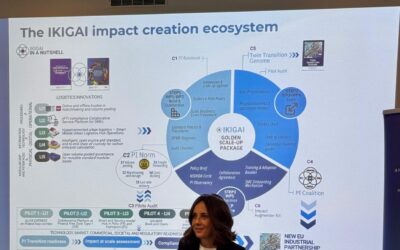
IKIGAI workshop “Towards Standards for the Physical Internet: Building the Foundations for Global Interoperability”
On 22 October 2025, the IKIGAI Project took part in the international workshop “Towards Standards for the Physical Internet: Building the Foundations for Global Interoperability”, held in Brussels and co-organised by ALICE (Alliance for Logistics Innovation through...

Why Is the project titled IKIGAI
In Japanese, ikigai means “a reason for being” – the point where what we love, what the world needs, what we are good at, and what we are paid for intersect. This concept is not just a name; it is the foundation of the IKIGAI Project’s purpose and vision.
IKIGAI represents a deeply held belief that the Physical Internet (PI) is essential to the future of logistics.

Project coordinator
ikigai@fitconsulting.it

This project has received funding from the European Union’s Horizon Europe research and innovation programme under grant agreement No 101202912. Views and opinions expressed are however those of the author(s) and do not necessarily reflect those of the European Union or the granting authority. Neither the European Union nor the granting authority can be held responsible