
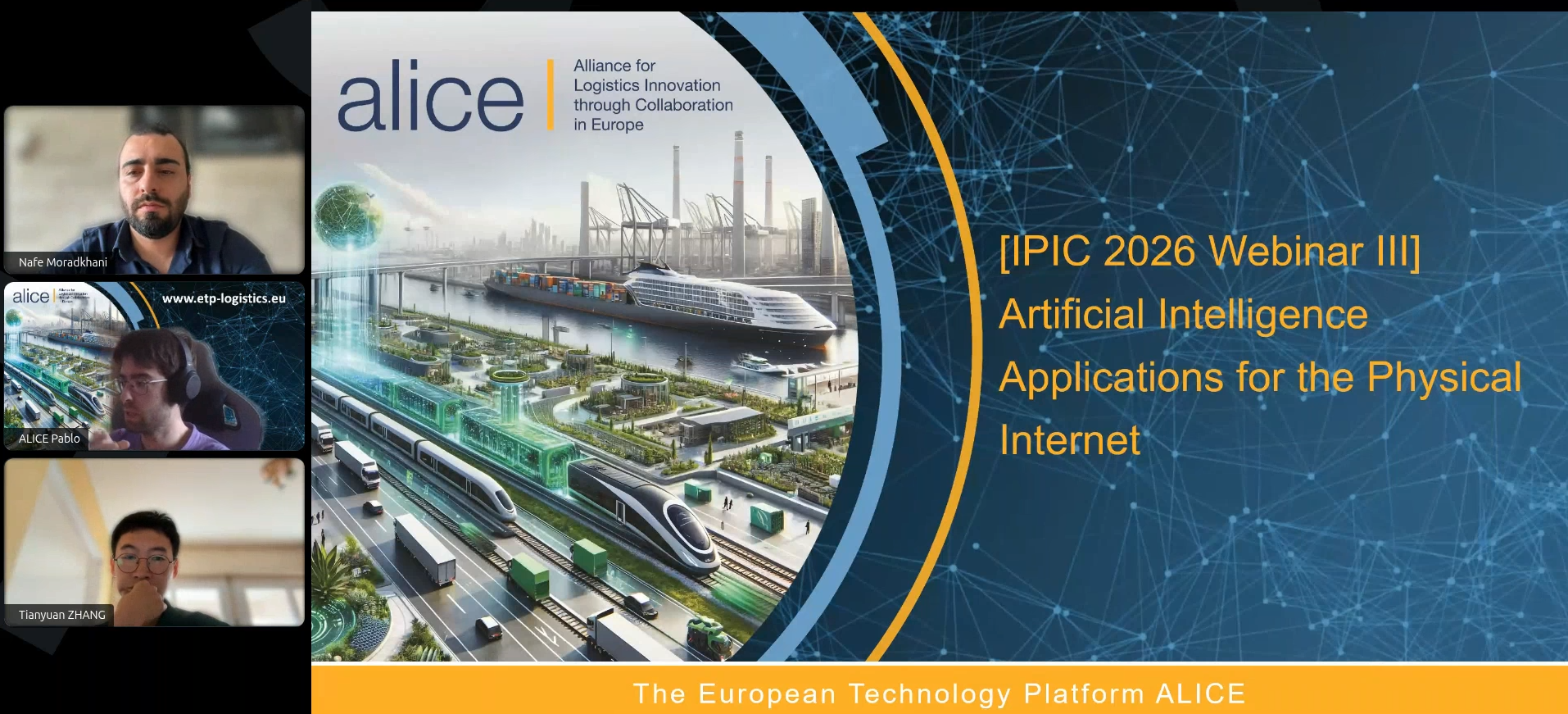
The third webinar in the IPIC 2026 series, Artificial Intelligence Applications for the Physical Internet, explored how artificial intelligence (AI) can support the transition towards more collaborative, efficient and zero-emission logistics systems.
Organised in collaboration with ALICE, the EU-funded IKIGAI project and KEDGE Business School, the session focused on how data-driven decision-making and optimisation methods can enable the operationalisation of the Physical Internet (PI), particularly in urban logistics.
Opening the session, Pablo Segura highlighted the role of AI within ALICE’s vision of climate-neutral and competitive freight transport. As a European Technology Platform, ALICE connects stakeholders across the logistics ecosystem to accelerate innovation through collaboration. Within this framework, the Physical Internet enables interconnected and shared logistics networks, while AI provides the intelligence required to manage complexity, coordinate flows and support real-time decision-making.
The webinar also reflected IKIGAI’s mission to accelerate the twin transition towards green and digital logistics through industry-led innovation. By demonstrating practical use cases, IKIGAI contributes to making Physical Internet concepts operational and scalable.
From open data to shared logistics maps
In the first presentation, Tianyuan Zhang addressed the lack of a shared spatial foundation in urban logistics. Currently, operators define delivery zones independently, while cities rely on administrative boundaries that are not suited to logistics operations. This fragmentation limits collaboration and complicates both planning and regulation.
The proposed framework, developed within the SOUL project, introduces a unified approach to urban logistics districting based on open data. By combining road network data and building information, the method creates a multi-tier structure of spatial units, ranging from small base units to larger operational districts. These are generated through clustering techniques and optimisation models, ensuring both scalability and reproducibility across different cities.
Applied to diverse urban contexts such as Bordeaux, Manhattan and Chengdu, the framework demonstrated strong adaptability. From a Physical Internet perspective, it provides a shared operational map that enables alignment between stakeholders, supports benchmarking and strengthens the basis for policy design.
AI-driven adaptive collaboration
The second presentation by Nafe Moradkhani focused on how AI can enable adaptive collaboration in logistics networks. While the Physical Internet promotes openness and resource sharing, the presentation emphasised that collaboration must be context dependent. Differences in operational constraints, demand patterns and local conditions mean that full collaboration is not always optimal.
The proposed approach combines machine learning with optimisation to determine when and how collaboration should occur. A predictive model evaluates contextual signals such as workload, congestion and service performance to estimate the appropriate level of openness. Based on this, optimisation models define operational decisions, including resource allocation and parcel transfers between actors.
The findings show that selective collaboration can significantly improve performance without requiring full system integration. Moderate levels of openness were sufficient to reduce overload and enhance resource utilisation, highlighting that adaptive and context-aware collaboration is a practical pathway towards implementing Physical Internet principles.
Conclusion
The webinar demonstrated that AI plays a key role in enabling the Physical Internet by supporting shared infrastructures, improving coordination and enabling more transparent, data-informed decision-making. These capabilities are essential to scaling collaborative logistics solutions and achieving zero-emission freight transport.
As IKIGAI continues to showcase innovation in this field, AI-driven approaches will remain central to advancing sustainable and interconnected logistics systems. The discussion will continue at IPIC 2026, where stakeholders will further explore the future of Physical Internet deployment.
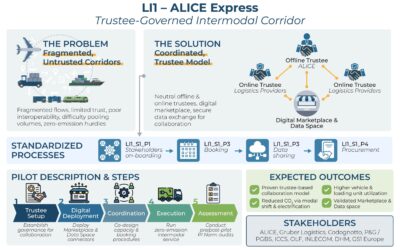
IKIGAI Logistics Innovations
The IKIGAI project continues to advance its portfolio of logistics innovations, strengthening alignment with the Physical Internet (PI) through the development of collaborative, standardised and digitally enabled logistics systems. By bringing together industry stakeholders, governance frameworks and interoperable technologies, IKIGAI demonstrates how freight transport can evolve towards scalable, zero-emission and interconnected networks.
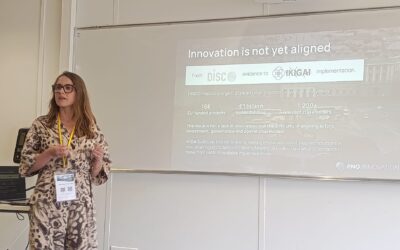
IKIGAI at IPIC 2026: Multimodal hubs, ports and deployable nodes
At IPIC 2026 in Bordeaux, the IKIGAI project showcased methodologies and tools to help scale Physical Internet innovations beyond pilot projects. Discussions highlighted the importance of interoperability, governance, stakeholder collaboration and readiness assessment to accelerate the deployment of scalable, zero-emission logistics solutions.
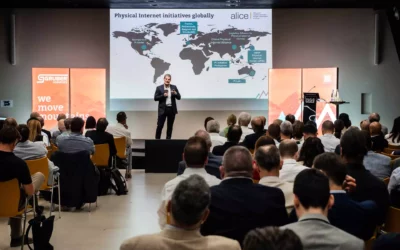
IKIGAI at Gruber Logistics Innovation Summit
At the Gruber Logistics Innovation Summit, Fernando Liesa and Sergio Barbarino highlighted the importance of collaboration in addressing the challenges facing logistics. Discussions focused on the Physical Internet, innovation deployment, automation and AI, emphasising that resilient and sustainable supply chains require not only technological advances but also stronger collaboration across organisations and stakeholders. Their contributions closely reflected the ambitions of the IKIGAI Project, which is accelerating the transition towards collaborative, interconnected and zero-emission freight transport systems.

Project coordinator
ikigai@fitconsulting.it

This project has received funding from the European Union’s Horizon Europe research and innovation programme under grant agreement No 101202912. Views and opinions expressed are however those of the author(s) and do not necessarily reflect those of the European Union or the granting authority. Neither the European Union nor the granting authority can be held responsible