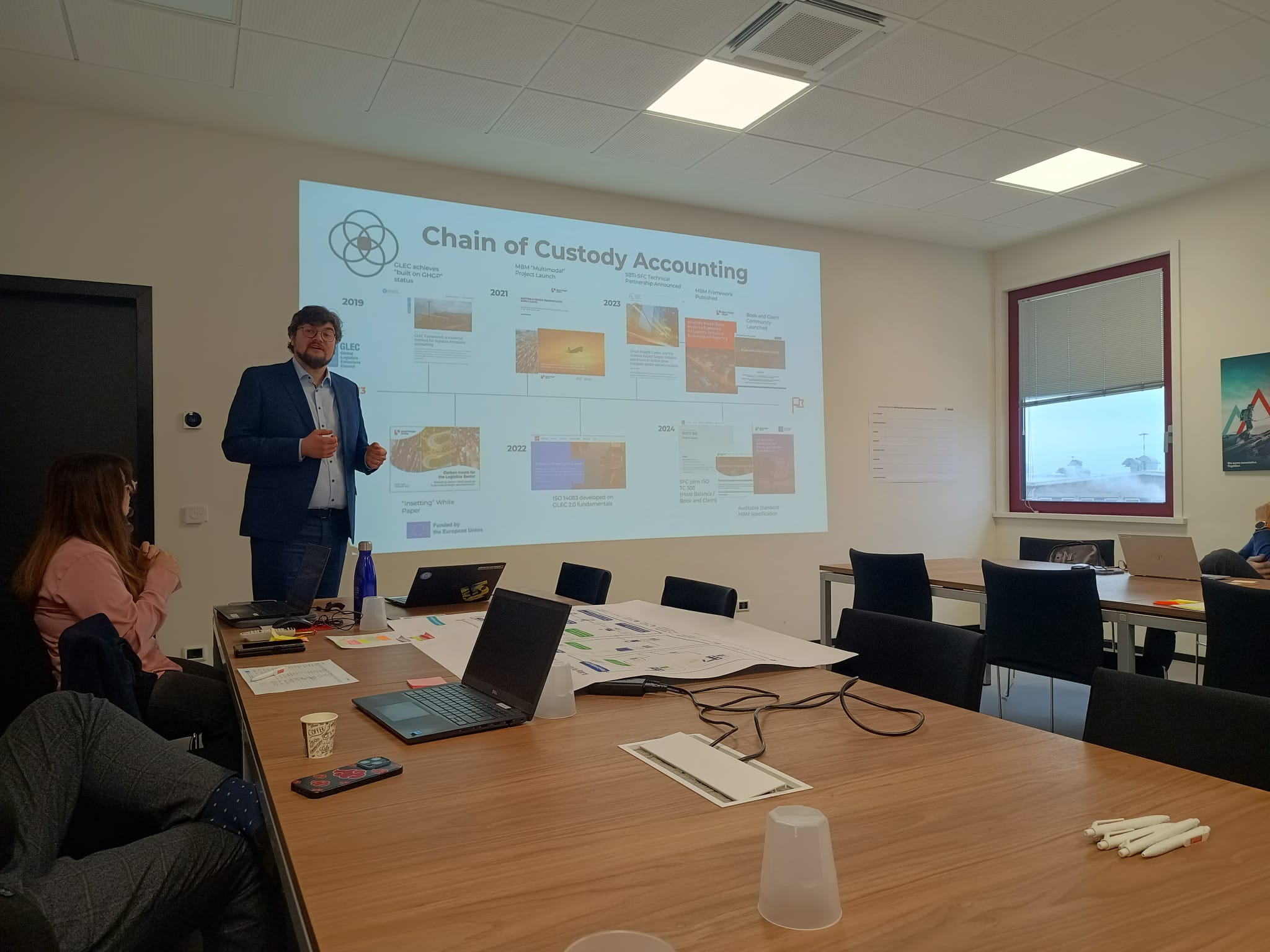
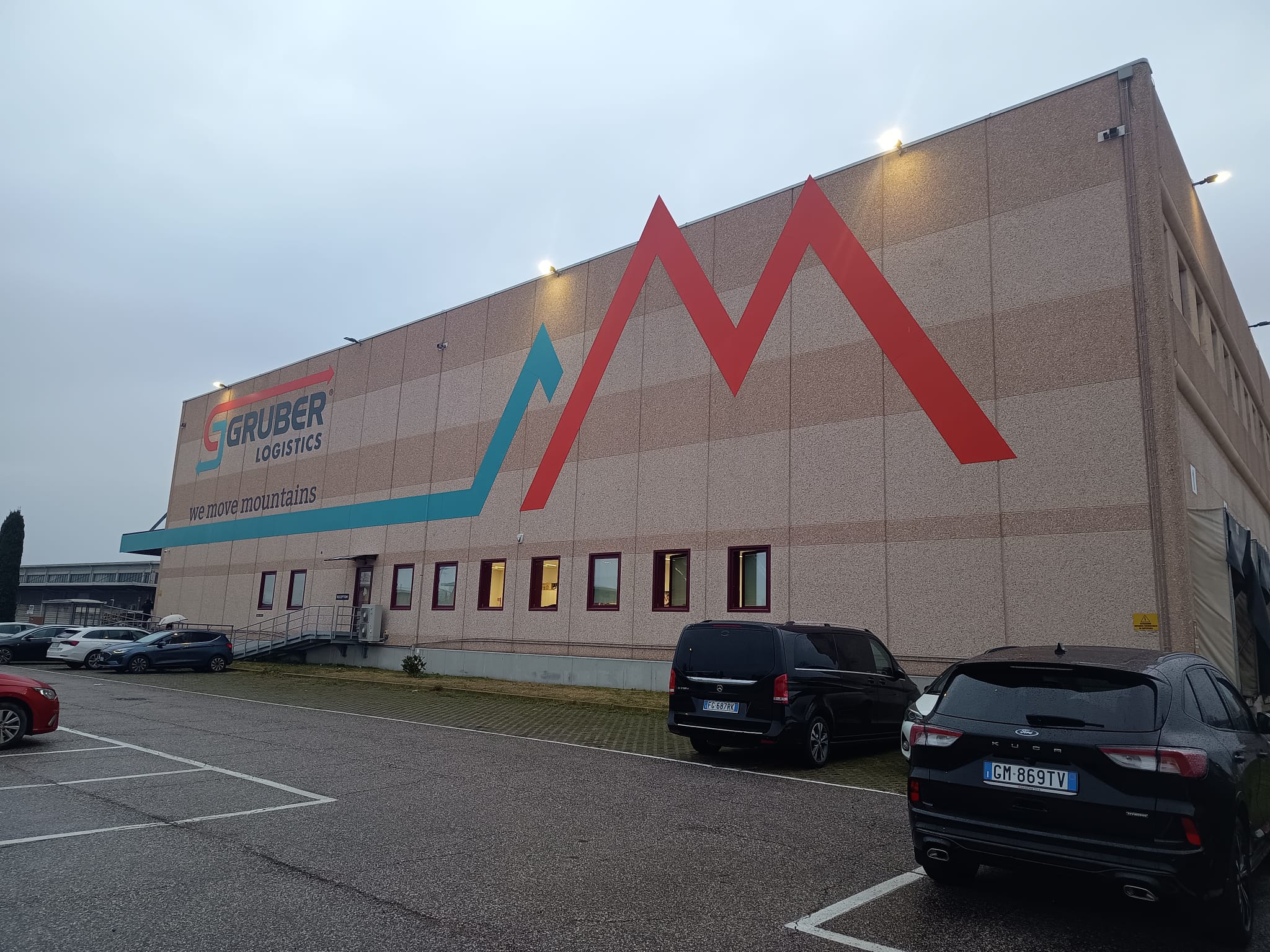
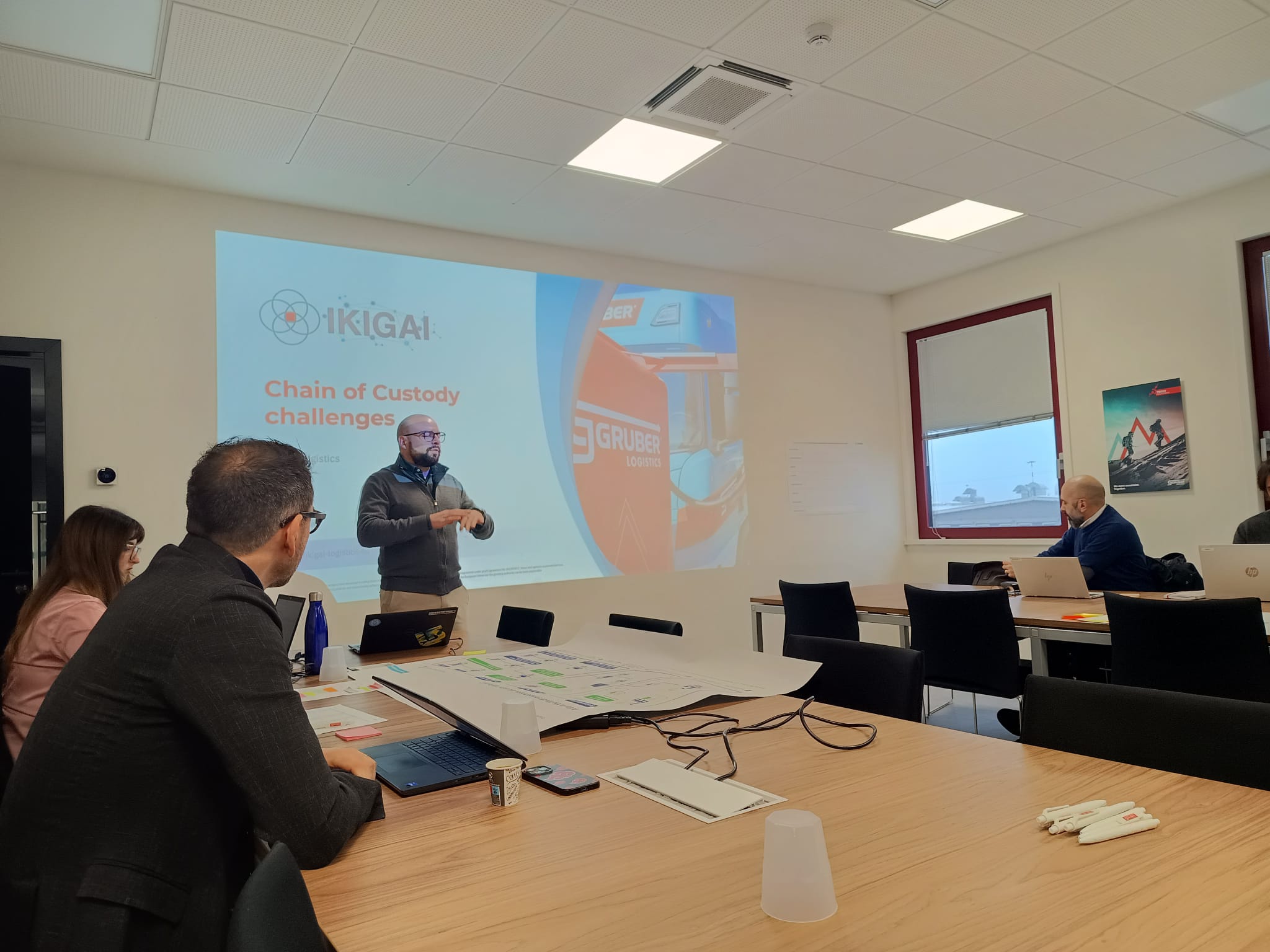
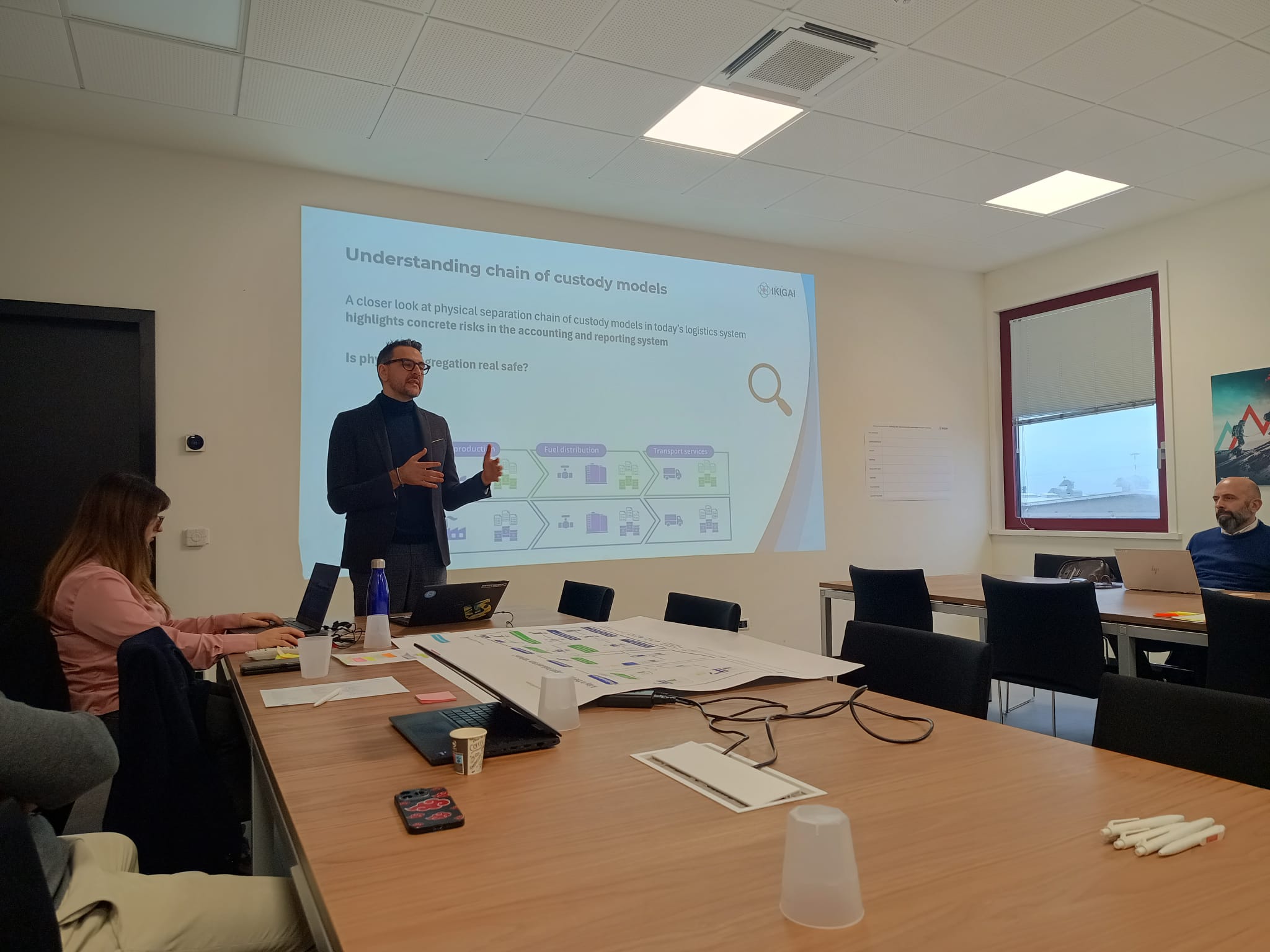
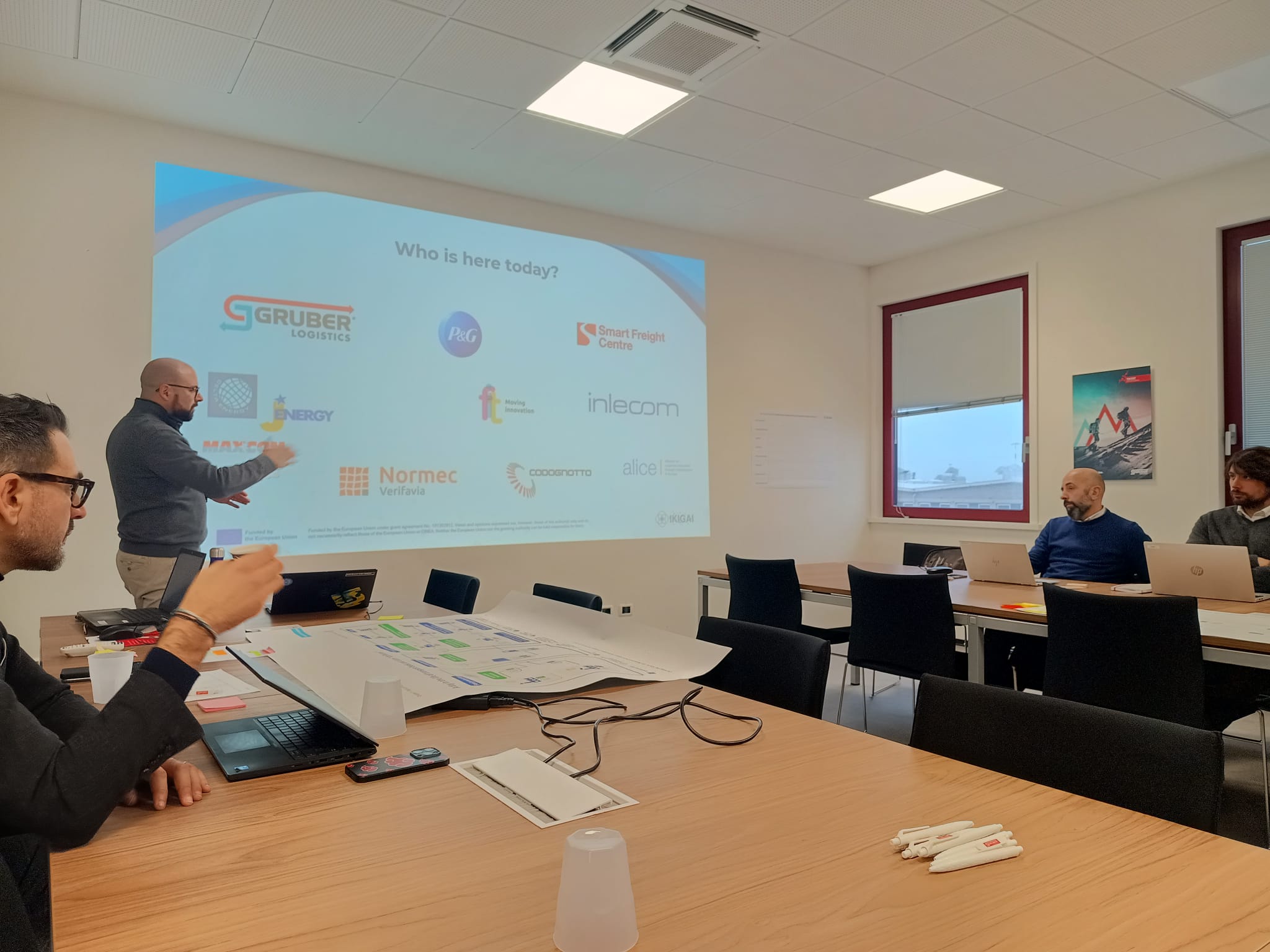
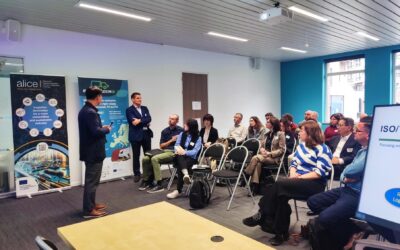
On 16 December 2025, IKIGAI partners and invited stakeholders met in Verona, Italy for the Task 3.5 Kick-off Meeting (KoM) workshop, focused on addressing Chain of Custody challenges in emission accounting for road freight, with a particular emphasis on Book & Claim (B&C) models for biofuels.
The meeting brought together 18 participants, including representatives from GRUBER Logistics, Smart Freight Centre (SFC), Procter & Gamble (P&G), Codognotto, FIT Consulting, fuel producers, verification bodies, and technology providers. Almost all participants were ALICE members, underlining the strong alignment between IKIGAI and the wider ALICE community.
Why Book & Claim matters for road freight?
Discussions confirmed that biofuels and Book & Claim mechanisms are becoming a critical short- to mid-term decarbonisation lever for road transport, particularly as large shippers recognise that full electrification will not be available at scale in the near future.
P&G highlighted its objective of establishing a trustworthy system that allows biofuel claims across complex subcontracting chains, even where physical fuel use cannot be directly matched to individual shipments. Cost considerations were recognised but not seen as the primary driver at this stage. Instead, trust, robustness and acceptance were identified as essential success factors.
Participants acknowledged that compromises between physical and digital accounting approaches will be necessary, especially when combining traditional location-based diesel reporting with market-based biofuel claims.
Key challenges identified
Across the workshop sessions, several structural challenges emerged:
- Fragmentation of the road freight sector, with many small carriers and limited access to primary data
- Lack of harmonised digital traceability systems linking fuel use, transport activity and claims
- Limited regulatory recognition of Book & Claim within frameworks such as the GHG Protocol and SBTi
- Verification complexity, particularly for third-party auditors assessing digital platforms without direct access to raw operational data
- Inconsistent national certification schemes, complicating cross-border application
Stakeholders agreed that physical segregation of fuels is rarely feasible in practice, especially from refuelling station level, reinforcing the need for credible B&C approaches supported by strong integrity measures.
Role of standards, verification and governance
Smart Freight Centre underlined the importance of alignment with existing frameworks, notably GLEC, ISO 14083 and the SFC Market-Based Measures (MBM) framework, rather than reinventing methodologies. However, participants also recognised that practical implementation guidance remains insufficient, particularly for logistics operators.
Verification bodies stressed the need for verifier access, transparency and clearly defined roles, noting that platforms alone cannot act as trustees. A recurring conclusion was that a trusted governance structure is required alongside digital systems to ensure credibility and acceptance.
IKIGAI T3.5: A collaborative framework built by the ecosystem
The IKIGAI Task 3.5 workshop confirmed that no single actor can solve Book & Claim challenges alone. Shippers, logistics service providers, fuel suppliers, certification bodies, technology providers and standard-setting organisations each face different constraints, responsibilities and risks along the value chain. Ensuring trust, acceptance and scalability therefore requires a collaborative, multi-stakeholder approach.
The objective is to move from fragmented practices towards a common, implementable approach that supports trustworthy low-emission transport services and can remain relevant beyond the lifetime of the project.
Next steps
The Verona workshop marked a critical foundation moment for Task 3.5. While the exact implementation pathway will be refined in the coming months, there was broad agreement that Book & Claim – when properly governed, verified and standardised – can unlock scalable decarbonisation for road freight.
IKIGAI will now move forward by consolidating inputs, engaging policymakers and market actors, and translating today’s complexity into practical, trusted solutions for low-emission transport services.
Webinar Physical Internet applications for containerised consolidation on public transport
Webinar explored Physical Internet applications for integrating freight into public transport, co-organised by IKIGAI, ALICE, DISCO, Shift2Zero and URBANE, highlighting urban and rural logistics improvements and emission reduction potential.
Strengthening global collaboration to advance the Physical Internet
The transition toward Physical Internet–enabled logistics is accelerating globally. The EU-funded IKIGAI project contributes by translating strategic vision into practical implementation through innovation, piloting and international cooperation supporting collaborative, interoperable and sustainable logistics networks.
Key takeaways from the International Expert workshop
An international expert workshop gathered researchers, industry stakeholders and standardisation experts to explore how innovation pilots and emerging logistics solutions can scale into interoperable Physical Internet systems supporting efficient, collaborative and zero-emission logistics networks.