
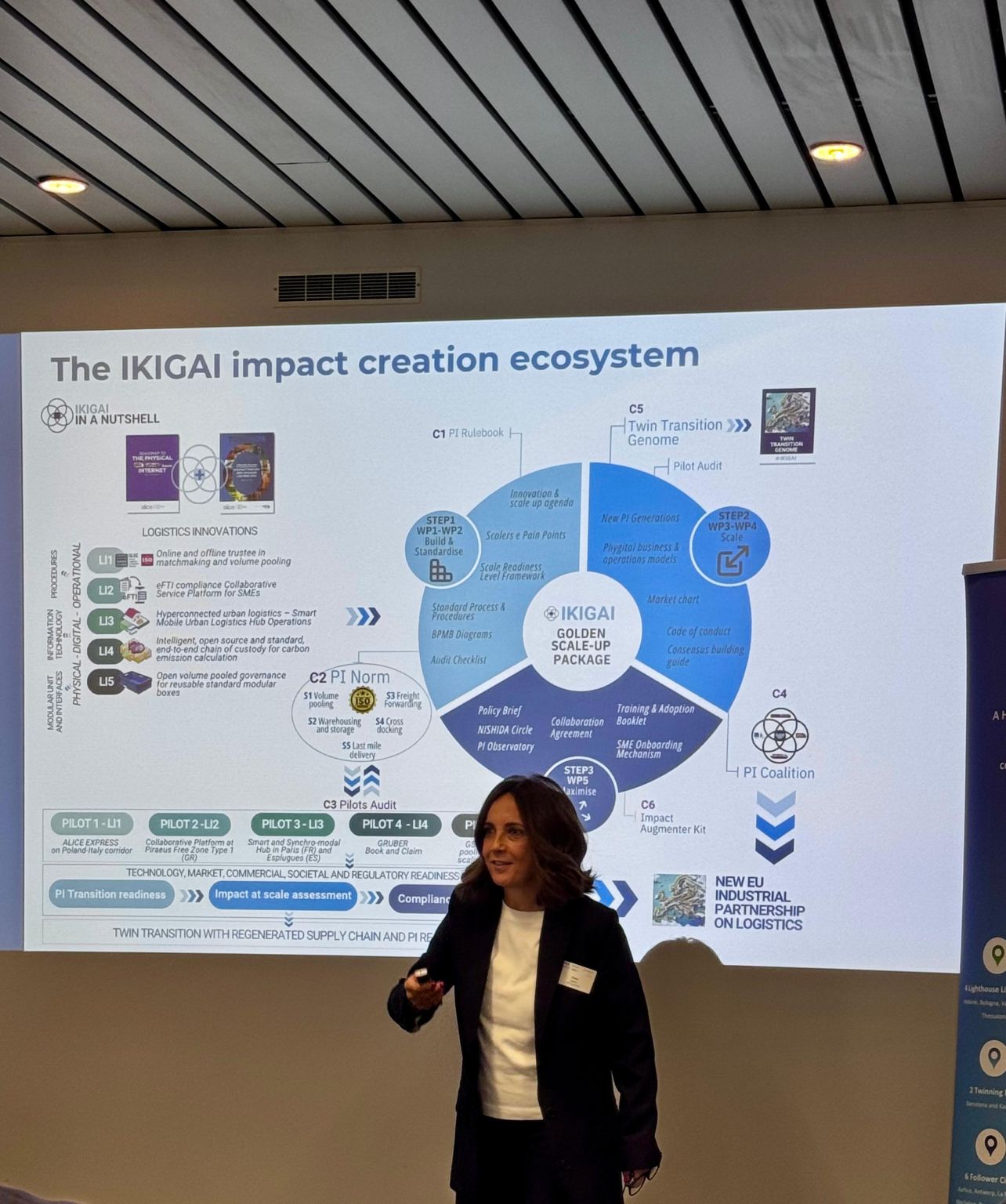
On 22 October 2025, an international expert workshop brought together leading researchers, industry stakeholders, and standardisation experts to discuss the standardisation needs required to scale up innovation and accelerate the implementation of the Physical Internet (PI) in logistics systems.
The workshop was organised in collaboration with several European research and innovation projects, including IKIGAI, alongside URBANE, DISCO, and Shift2Zero. The discussion focused on how innovation pilots and emerging logistics solutions can transition from experimentation to large-scale, interoperable deployment across Europe and beyond.
IKIGAI supported the workshop as part of its mission to accelerate the transition toward zero-emission freight transport and Physical Internet-enabled logistics networks. The discussions provided valuable insights into how research, innovation, and standardisation must evolve together to transform logistics into an open, efficient, and collaborative system.
Why the Physical Internet needs standards
The Physical Internet represents a vision for logistics where goods move through open, interconnected networks, similar to how data flows through the digital internet. In this model, freight can be transferred seamlessly between transport modes, hubs, and logistics operators using shared infrastructure and interoperable systems.
However, the workshop highlighted that while many promising pilots already exist, fragmentation remains a major barrier. Solutions are often developed independently, using different technologies, data formats, or operational models. Without harmonised standards, these innovations cannot easily connect to form scalable logistics networks.
Participants emphasised that standardisation is the key mechanism that can transform isolated innovations into a functioning Physical Internet ecosystem.
Urban logistics as a testing ground for the Physical Internet
Cities are emerging as a natural entry point for Physical Internet implementation. Rapid growth in e-commerce, rising delivery demand, congestion, and environmental pressures are forcing cities to rethink how goods move through urban areas.
Several innovation approaches already demonstrate how PI principles can improve urban logistics:
- Shared micro-hubs enabling consolidation of freight flows close to city centres
- Parcel lockers accessible to multiple logistics providers
- Modular loading units and right-sized electric vehicles for efficient last-mile delivery
- Digital platforms coordinating logistics actors and assets
These solutions improve efficiency, reduce emissions, and make better use of limited urban space. Yet the workshop emphasised that their broader replication across cities depends heavily on common standards.
The growing importance of global collaboration
Another key theme was the increasing international momentum around Physical Internet implementation. Experiences from Asia, particularly Japan and South Korea, demonstrate how coordinated approaches combining innovation, governance, and standardisation can accelerate progress.
For example, the Physical Internet Maturity Model (PIMM) developed in Japan provides organisations with a framework to evaluate their readiness for PI implementation and track progress toward collaborative, interoperable logistics ecosystems.
At the same time, international standardisation bodies such as ISO are developing standards related to urban logistics systems, parcel lockers, unmanned retail environments, and last-mile delivery services, which are critical components of future Physical Internet networks.
The workshop discussions highlighted the need for stronger global cooperation to ensure that emerging standards remain aligned and interoperable across regions.
Key takeaways from the workshop
The workshop produced several strategic conclusions for scaling the Physical Internet:
- Standardisation is essential for scaling innovation
Technological solutions already exist, but their impactremains limited without common standards that enable interoperability between logistics actors and systems. - Focus on targeted, practical standards first
Rather thanattempting to standardise the entire logistics system, efforts should prioritise key components such as modular containers, data exchange formats, and shared urban infrastructure. - Strengthen collaboration between R&I projects and standardisation bodies
Research and innovation projects generate valuable technical knowledge that can inform future standards. Early engagement with standardisation organisations is therefore essential. - Continue implementing pilots while standards evolve
Real-world experimentation should continue alongside standardisation processes, providing practical evidence and feedback that helps refine emerging standards.
The role of IKIGAI in shaping the future of logistics
For IKIGAI, supporting initiatives such as this workshop is part of a broader effort to connect innovation, industry, and policy to accelerate the adoption of Physical Internet solutions.
By demonstrating new logistics models, enabling digital collaboration across supply chains, and promoting zero-emission freight transport, IKIGAI contributes to building the foundations for open, efficient, and sustainable logistics networks.
The workshop discussions reaffirmed that achieving the Physical Internet vision requires continued collaboration across projects, industries, and regions. Through initiatives like IKIGAI, Europe is helping shape the next generation of logistics systems -moving from isolated innovations toward interoperable, scalable, and climate-neutral freight transport.
The full workshop report, including detailed figures, policy recommendations, and a complete record of the discussion, is available exclusively to ALICE members via the Knowledge Platform.
Webinar Physical Internet applications for containerised consolidation on public transport
Webinar explored Physical Internet applications for integrating freight into public transport, co-organised by IKIGAI, ALICE, DISCO, Shift2Zero and URBANE, highlighting urban and rural logistics improvements and emission reduction potential.

Strengthening global collaboration to advance the Physical Internet
The transition toward Physical Internet–enabled logistics is accelerating globally. The EU-funded IKIGAI project contributes by translating strategic vision into practical implementation through innovation, piloting and international cooperation supporting collaborative, interoperable and sustainable logistics networks.

IKIGAI and partners publish white paper on book and claim
IKIGAI contributed to a Smart Freight Centre-led white paper on implementing book and claim for low-emission road freight. With input from P&G, Normec Verifavia and GRUBER Logistics, it provides a verified, standardised framework enabling credible, scalable emissions reporting.